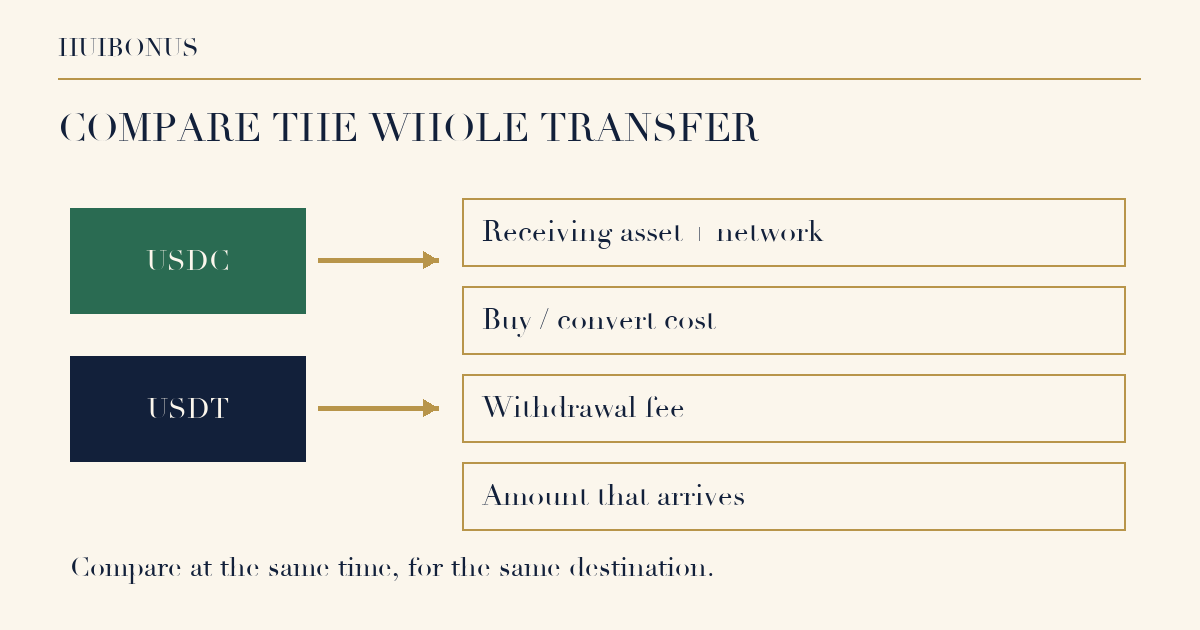
For a transfer, the first question is what the recipient accepts. If they accept only USDT on a particular network, sending USDC does not satisfy those instructions even if the tokens have similar market prices. If they accept both, compare complete routes to the same receiving outcome.
The useful comparison includes what you already own, whether you need to exchange it, the available withdrawal networks, and what the recipient will actually receive. A lower withdrawal fee can be outweighed by an extra conversion or by sending an asset the recipient must convert again.
Compare the asset and the service separately
| Question | USDC | USDT |
|---|---|---|
| Who issues it? | Circle issuing entities | Tether |
| Where can I inspect issuer information? | Circle reserve disclosures and supported-network documentation | Tether reserve disclosures and supported-protocol information |
| Can this platform receive it? | Check that platform’s supported token, version and network. Issuer support alone is insufficient. | |
| Can I redeem directly? | Circle Mint has institutional eligibility requirements. | Tether sets account, minimum-amount and fee requirements. |
| Is the value guaranteed by the ticker? | No. Market prices can depart from the intended dollar peg. | |
Read Circle’s disclosures and Tether’s disclosures for issuer information. These help answer questions about the token and its reserves. They do not confirm a particular exchange’s deposit support, prove that a transfer arrived or quote the cost of your next withdrawal.
There are several distinct risks. The token’s market price may move away from its peg. An issuer or platform can have restrictions or service interruptions. Separately, a user can select an unsupported asset or network. Checking the transfer route reduces operational mistakes; it does not remove the risks of holding the token.
Use different evidence for three different questions
For “what token is this?”, start with the issuer’s supported-network and contract documentation. For “will my account receive it?”, use the receiving platform’s deposit instructions. For “how much will this payment cost?”, use the actual conversion and withdrawal confirmations. A positive answer from one source does not answer the other two questions.
Keep those checks specific. A platform listing USDC in its markets shows that it has some support for trading that asset; it does not mean every USDC network is available for deposits. A network appearing on the issuer’s website does not mean your selected exchange has enabled that route for your account.
If the receiving page is unavailable or the network is paused, you do not yet have a complete route to compare. Record the missing condition and ask the recipient to confirm a supported alternative. Treat a past successful deposit as useful history, not as current confirmation of service availability.
Selling, withdrawing and redeeming are different operations
Selling USDC or USDT on a trading platform exchanges it under the terms of that trade. A blockchain withdrawal transfers the token to a destination address. Direct issuer redemption uses the issuer’s service and its eligibility requirements. The fact that an exchange lets you withdraw a token does not mean the issuer will wire dollars to you on request.
Circle Mint is an institutional product and is not offered to individuals. Other redemption arrangements can have different eligibility: qualifying EEA holders may use Circle’s MiCA redemption process, subject to its verification and other requirements. Tether’s fee page separately sets out conditions for direct acquisition and redemption. Do not apply either product’s fee schedule to an exchange withdrawal.
For someone using a retail exchange, the immediately available choices may be trading, converting or withdrawing within that service. Check the route you can actually use. A direct-redemption statement in an issuer’s documentation is not a substitute for confirming your account’s eligibility or the practical steps needed to receive the desired asset.
Match the network and the token version
If two chains both say USDC, is that one balance?
No. A balance on one network is not automatically available at the same address on another. The transfer must use a supported route between the networks; changing a withdrawal dropdown does not itself bridge your assets.
Circle’s contract-address list identifies USDC by network. This is useful when identifying a token, but a contract address is not the receiving address for your payment. Get the destination from the receiving platform or wallet.
Also distinguish native, bridged and wrapped versions when the receiving service does. Similar tickers do not prove that two tokens are interchangeable for deposits. If a platform accepts a particular version, use the full asset and network details it specifies.
Address appearance adds another source of confusion. Several EVM-compatible networks use 0x addresses. The same string can appear on more than one network, with separate balances. A valid-looking address therefore cannot tell you which USDC or USDT route the recipient accepts.
For a self-custody wallet, confirm the wallet supports the intended network and can display the token. If the recipient plans to send it onward, they also need to consider that network’s transaction-fee requirements. An exchange handling a withdrawal fee for the first leg does not cover every later wallet transaction.
Reused addresses do not prove deposit support
Can I deposit USDC into a USDT address, or the other way around?
Do not assume so. Some services reuse addresses, but credit depends on the token, network and version they support. Select the asset you will actually send on the receiving deposit page and follow those instructions. A transfer does not automatically exchange USDC for USDT.
If you copied a USDT address and later decide to send USDC, reopen the receiving page with USDC selected. Confirm its supported network, address, minimum and any additional requirements. An identical address after that check can be legitimate; the check is about support, not about the characters changing.
If you already sent the wrong token, inspect the actual token transfer and its network using the TxID. A successful transaction is evidence of execution, not evidence that the exchange credited the requested asset. Use the receiving platform’s incorrect-deposit or missing-deposit process.
The sender’s available balance is another separate issue. A USDC-quoted trading pair uses USDC as its quote asset; having USDT elsewhere in the account does not make those two balances identical. Before exchanging, check the direction of the trade and the asset the confirmation says you will receive.
Compare complete routes to the same outcome
Begin with an explicit target: the recipient needs a specified amount of USDT, or accepts either token under stated terms. Without that target, comparing one USDC fee with one USDT fee may compare two different services.
- Write down the asset and amount you already hold.
- List only routes the recipient supports, including the exact network and token version.
- If a conversion is needed, inspect its current quote, direction, amount received and any separately listed fee.
- Inspect the withdrawal confirmation for the fee, total deduction and expected received amount.
- Check that both the withdrawal minimum and the recipient’s deposit minimum are met.
- Compare the total cost of delivering the same agreed result, using quotes obtained under comparable conditions.
If a conversion quote already includes a cost in the amount received, do not count that same cost again as an additional deduction. Likewise, determine whether the withdrawal fee is subtracted from the entered amount or charged in addition to it. The confirmation’s total deduction and received amount are more useful than assuming a fee convention.
| Route detail | Why it matters |
|---|---|
| Starting asset and target receipt | Keeps the comparison focused on the same payment |
| Conversion result | Captures any extra exchange step before withdrawal |
| Withdrawal fee and total deduction | Shows the cost of sending from this platform |
| Expected received amount | Can be checked against the payment obligation and deposit minimum |
| Any conversion required after receipt | Avoids shifting an uncounted cost to the recipient |
Which one has the lower fee?
There is no universal answer. Compare the live confirmations for routes that deliver the same required asset and amount. Include any necessary conversions; do not infer the cheaper route from the token name or a previous withdrawal.
Consider a simple example without live prices: you hold USDT and the recipient wants USDT. Sending USDT on a mutually supported network is one route. Converting to USDC, sending it, and having the recipient convert back is another. The latter includes two conversion steps, so a smaller withdrawal fee alone does not make it cheaper.
A quote can change before you submit. If you change the amount, network or conversion direction, inspect the confirmation again. A paused route or one that falls below a minimum is not a usable low-cost option at that moment.
A worked comparison using fictional amounts
The following figures are invented solely to illustrate the arithmetic. They are not current fees, quotes or a recommendation for either asset. Assume you start with 1,000 USDT and the recipient ultimately needs USDT. Both routes in the example meet all account, network and minimum-amount requirements.
| Stage | Direct USDT route | Route using USDC between conversions |
|---|---|---|
| Start | 1,000 USDT | 1,000 USDT |
| Initial conversion | None | Quote delivers 999 USDC, with its conversion cost already included |
| Withdrawal | Assumed fee of 2 USDT deducted; 998 USDT arrives | Assumed fee of 1 USDC deducted; 998 USDC arrives |
| Recipient’s conversion | None | Assumed quote delivers 997 USDT |
| Final outcome | 998 USDT | 997 USDT |
The USDC withdrawal has the smaller numerical fee, but the complete route delivers less USDT under these assumptions. The comparison becomes meaningful only after bringing both routes back to the same final asset. Comparing 998 USDC with 998 USDT as if they were automatically identical would skip the recipient’s conversion.
If the recipient instead agreed to keep USDC, remove the final conversion from the route and define the payment obligation accordingly. That is a different target, so the previous conclusion no longer answers the new question. An equal number of tokens is not by itself proof of an equal payment value.
For a fixed receipt requirement, such as exactly the agreed USDT amount, work backwards from the withdrawal confirmation’s received amount rather than assuming the entered withdrawal amount will arrive unchanged. Use the actual quote to determine the starting cost. The fictional figures above cannot supply that quote.
Keep the fee units visible
Record both the number and its asset: a fee shown in USDT, USDC or a network’s native token is not just an interchangeable number. If costs are in different units, you need an explicit valuation basis to combine them. Otherwise keep them as separate line items instead of producing a misleading total.
For a one-off comparison, note the quote time and the route details beside the calculation. If the recipient obtains a later conversion quote, update that leg before describing the final result. A comparison using yesterday’s conversion rate and today’s withdrawal fee is not a single executable quote.
Also distinguish a fee from a price movement between two checks. If the quoted amount changes when you refresh, compare the quote details before attributing the entire difference to a new charge. The received amount already includes any cost embedded in that quote; only add separately charged items once.
Give the recipient an unambiguous payment instruction
If you are receiving, specify the token, full network name, current address, required tag and agreed received amount. “Either stablecoin is fine” is useful only when you have actually checked both routes and agreed who handles any later conversion.
Agree who handles each remaining step
If you use an exchange order for the conversion and only part of it fills, recalculate from the completed quantity. You may now hold both the original token and the acquired token, while an open order still reserves some balance. A planned withdrawal of the full quoted amount may no longer be possible. Check the order’s final status and available balances before preparing the transfer; do not count an unfilled quantity as an asset already obtained. This is another reason to retain separate conversion and withdrawal records.
Before paying another person, establish whether “received” means credited to their exchange account, visible in their wallet, or converted into a particular asset. Those endpoints involve different work. Agree on the endpoint before comparing fees, particularly when one route shifts a conversion or an onward network transfer to the recipient.
If the recipient changes the required token after you have already converted, pause before creating another conversion. Recheck what you now hold, what they now accept and the cost of completing the revised route. The initial plan is no longer the relevant starting position.
After completion, compare the actual conversion result, withdrawal deduction and recipient’s credit with your plan. Save each reference separately. An exchange trade record explains the conversion; a TxID explains a blockchain transfer; the receiving platform’s credit record confirms its account outcome. None of those records alone describes every leg.
For a first transfer to a new destination, use a test amount that meets the receiving minimum and wait for the recipient to confirm credit. Keep the route unchanged for the remainder. Use the pre-send checklist to check the operational details after making the comparison.