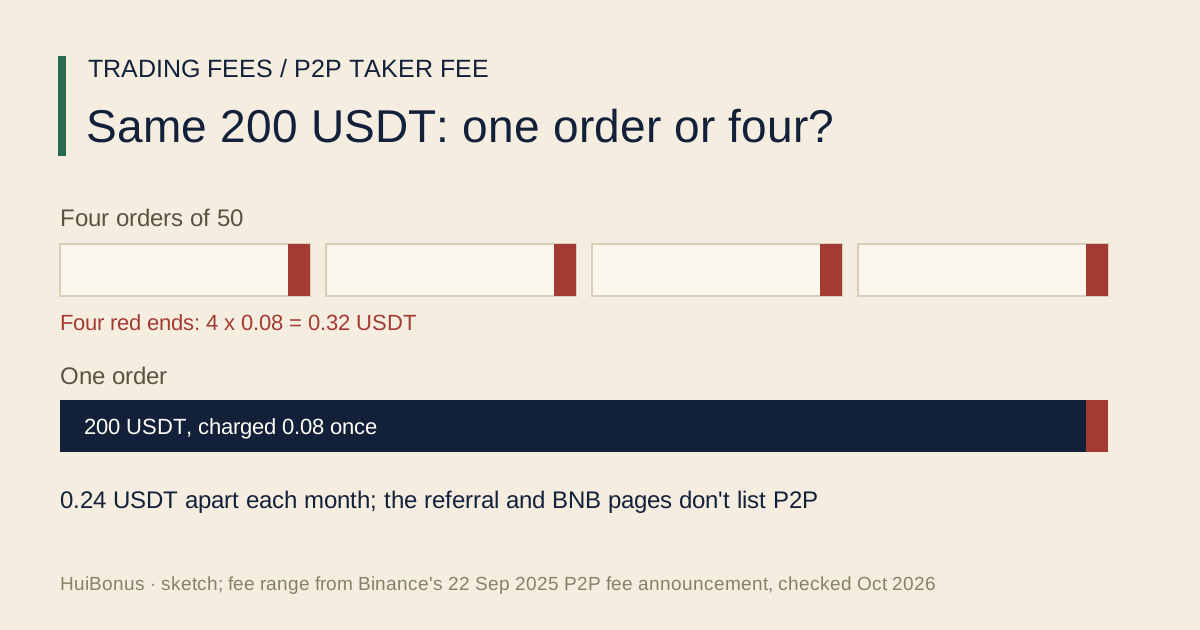
Say you need 200 USDT this month. You could take it in four bites from the P2P Zone, 50 USDT an order. Or you could find one advert with a big enough limit and buy the lot in one go. Same price per USDT either way. What's the difference in actual money?
Binance's September 2025 announcement sets a flat taker fee of 0.06 to 0.08 USDT per order for USDT pairs in the P2P Zone, in the listed fiat markets. Take the top of that range. Four orders cost 0.32 USDT; one order costs 0.08. That's 0.24 USDT apart for the month. Small, yes. But it's charged per order, not per dollar, so the more you split, the bigger the bite out of each one. Below: which notice set the fee, whether your order is caught by it, whether a referral code or BNB touches it, and how to pull apart a short delivery.
Which announcement set this fee
P2P didn't always charge takers. Three notices got it here, and they don't charge the same way:
- September 2023: Binance Lite and the P2P Express Zone started charging takers in selected fiat markets, as a percentage, 0.1% to 0.2% depending on the market and pair.
- March 2024: USDT pairs in the P2P Zone switched to a flat taker fee, 0.05 USDT per trade order.
- 22 September 2025: that flat fee moved to 0.06–0.08 USDT per trade order, rolled out gradually and set to finish by the end of December 2025.
All three say the same thing about the other side: maker fee rates stay unchanged. The maker is whoever posted the advert. If you click someone else's ad and place the order, you're the taker, and this fee lands on you.
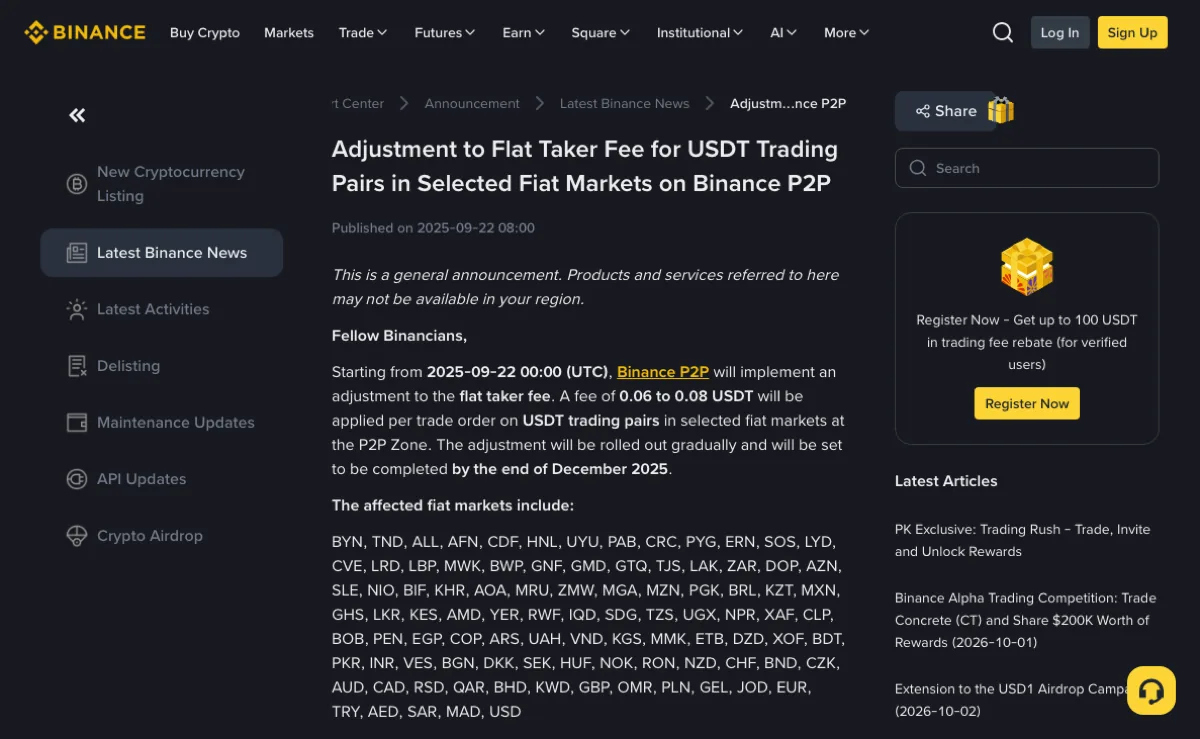
The words that matter are "per trade order". Not a percentage of what you buy. One order, one charge.
Is your order on the list?
Two things to pin down: which zone you ordered in, and which fiat you paid with.
Zone first. The P2P Zone is the page where you browse adverts yourself and can see each merchant and their price. The Express Zone is the one where you type an amount and the system matches a merchant for you. The flat 0.06–0.08 is written for the P2P Zone. Express, going by the 2023 notice, is charged as a percentage; if it has changed since, none of these announcements say so, so treat that as unconfirmed.
Then the fiat. The 2025 notice is a long run of three-letter currency codes, and USD, EUR, GBP, AUD, CAD, AED and INR are all in it. Look for the code of the currency you actually pay in. If it's there, every USDT purchase you make in the P2P Zone carries this fee.
What the list doesn't tell you is whether your market pays 0.06 or 0.08. Binance's Introduction to Binance P2P Trading only says that Binance P2P "may charge transaction fees from takers/makers for every completed order", and points you to the fee page. The P2P section of that fee page only shows up once you're logged in, and discounts there vary by P2P user level. So the exact figure for your order lives on two screens only: the logged-in fee page and the order confirmation. This article can give you the announced range, nothing tighter.
Charged per order, so count per order
A flat fee hurts small orders most. The same 0.08 on a 20 USDT order and on a 500 USDT order is more than twenty times apart as a share:
| Order size | Fee at 0.06 | Fee at 0.08 | Share of the order |
|---|---|---|---|
| 20 USDT | 0.06 | 0.08 | 0.30% – 0.40% |
| 50 USDT | 0.06 | 0.08 | 0.12% – 0.16% |
| 100 USDT | 0.06 | 0.08 | 0.06% – 0.08% |
| 200 USDT | 0.06 | 0.08 | 0.03% – 0.04% |
| 500 USDT | 0.06 | 0.08 | 0.012% – 0.016% |
For a yardstick, the regular-user spot taker fee on Binance's fee schedule is 0.100%. A 20 USDT P2P order pays a bigger slice than a spot taker does. At 0.08, the order has to be above 80 USDT before the flat fee drops under that 0.100%.
Back to the 200 USDT. Four orders instead of one costs an extra 0.24 a month, or 2.88 USDT over twelve months. That sum only holds if you were going to buy 200 anyway and the choice is just how many orders. Buying more than you need to spread the 0.08 thinner is a different calculation, and not one this page is going to make for you.
Whether one order is even possible depends on the advert's per-order limit and how much the merchant has left. If you're inside the limit and the order still won't go through, the reasons are in P2P order within limits but cannot buy USDT.
The flat fee only cares how many orders you place. Buy the same amount in half as many orders and this line is halved.
A referral code or BNB won't touch this one
Where does a referral discount actually come from? Binance's Introduction to the Binance Referral Program builds commissions and rebates out of fees on spot, margin and futures trades. P2P shows up on that page in one place only, as a way for a referred friend to make a qualifying first purchase under Referral Lite. It isn't listed as a fee the rebate is paid from.
Same with BNB. The BNB fee discount page (updated February 2026) says you can save up to 25% on spot and margin trading fees and up to 10% on futures. P2P isn't mentioned.
So, reading the official pages as written, neither a referral code nor BNB reaches this 0.06–0.08. The referral discount shows up later, on your spot and futures fees. How it combines with BNB, and where the credit lands, are covered in Binance referral rebate and the BNB fee discount and Used a Binance referral code but your trading fee didn't drop?.
Reconciling: not every missing cent is a fee
The order completes and you've got less USDT than you expected. Before you blame the fee, split the gap into three places:
- The price. The merchant sets the advert price. Whatever sits above the exchange rate in your head is spread, not a Binance fee. Pay 100 USD at a price of 1.02 and you were only ever getting about 98.04 USDT, before any fee.
- The flat taker fee. The 0.06–0.08 above. None of the three notices says which side it comes off or what it's called on the order page. So open the order details and look for a separate fee line. If there is one, check against it. If not, work out amount paid ÷ price, subtract what actually arrived, and that difference is the bit worth asking about.
- Your bank's end. The P2P introduction page says it plainly: "your payment service providers may charge additional fees." That charge isn't on the Binance order at all. Who should carry it, and how to raise it with the merchant, is in Buying USDT on P2P: who pays the bank fee?.
Once those three are separated, whatever still doesn't add up is what you take to support, with the order number. For the checks to run before you pay — payer name, release order and the rest — see Buy USDT on Binance P2P: checks before you pay.
Is buying USDT on Binance P2P still fee-free?
Not in every case. Under Binance's 22 September 2025 announcement, USDT pairs in the P2P Zone charge the taker a flat 0.06 to 0.08 USDT per order in the listed fiat markets, and maker fee rates are unchanged. Whether your order pays it, and exactly how much, is shown on the logged-in fee page and the order confirmation.
Can BNB or a referral code reduce the P2P taker fee?
Not according to the official pages. The BNB fee discount page (updated February 2026) covers spot, margin and futures trading fees only, and the referral programme page builds rebates from spot, margin and futures trades. Neither lists P2P orders as a fee source.
I received less USDT than I paid for. Is all of that the fee?
Not necessarily. First look at the advert price: anything above the market rate is the merchant's spread. Then check the order for a separate flat taker fee line. Last, see whether your bank or payment provider charged its own transfer fee. If there's still a gap after those three, take the order number to support.