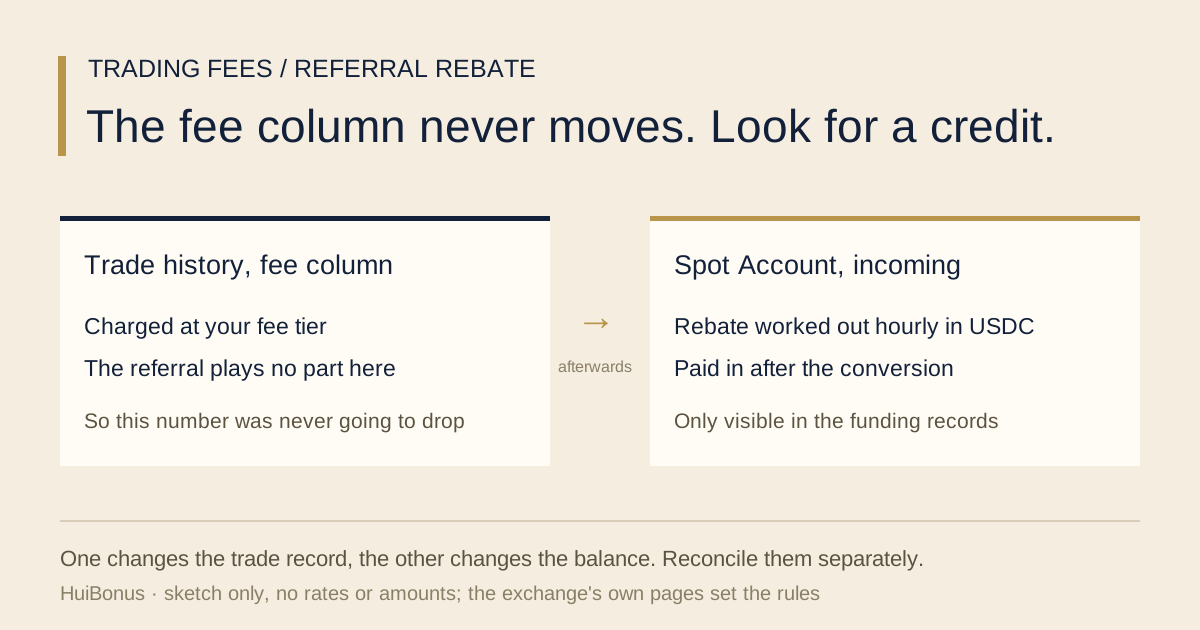
The fee on your trade history will not shrink because you signed up with a referral code. That is how the scheme is built. It does not mean the code failed to bind.
Price matches, quantity matches, and the fee column is charged at exactly your normal tier with no sign of a discount anywhere. That does not show the code failed. Do not close the account and sign up again with the code entered either. Re-registering is the one move most likely to lose you money, and the last section explains why.
The discount travels by a different road. The fee is charged in full at the trade, and a separate amount is worked out afterwards and paid to you. You will not find it on the trade line: the money lands in your Spot Account, and the record sits under Referral Rewards.
The fee on the trade line was never going to change
Trade history records what happened at the moment of the fill: the price, the quantity, the fee tier applied and the fee taken. The referral relationship has no say in that calculation. It comes in later.
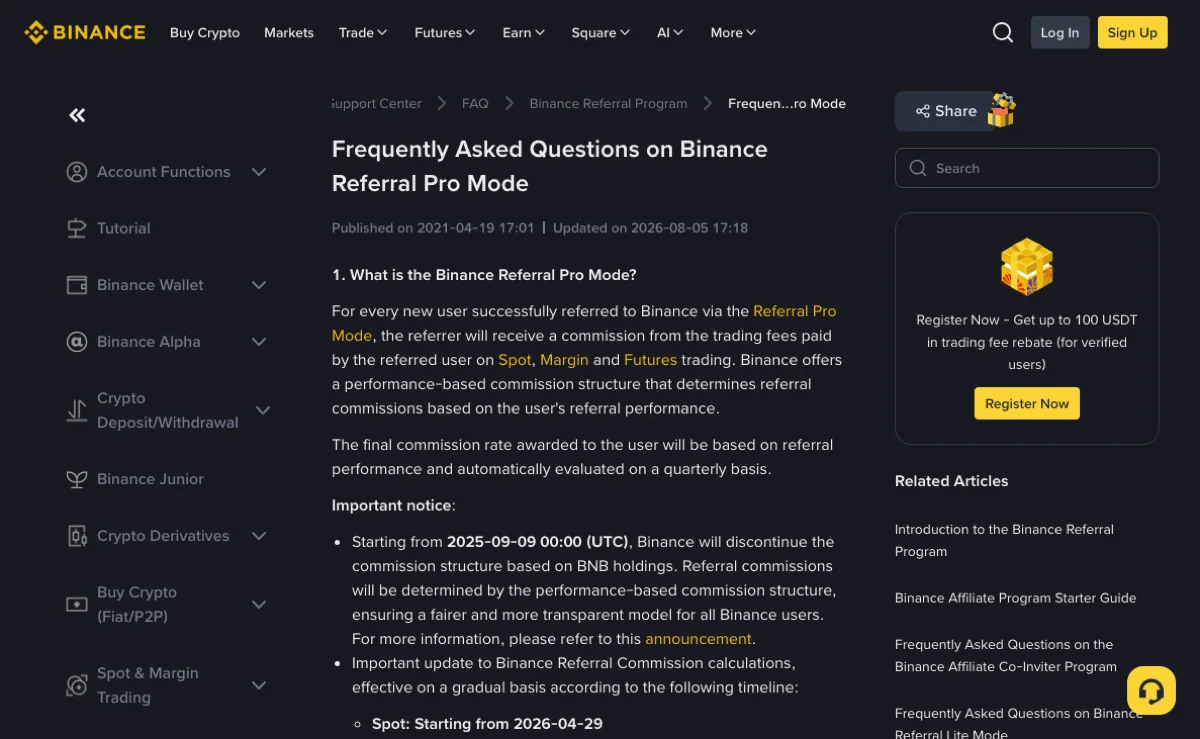
Binance's help centre page on Referral Pro Mode spells out the order plainly. The referrer receives a commission from the trading fees the referred user pays on Spot, Margin and Futures. When the referred user completes a trade, the referrer gets the commission first, and the referred user receives the rebate only if the referrer chooses to share it.
Two things in that description are easy to read past.
- It happens afterwards. There has to be a fee before there is anything to split. No fee, and nothing further down the chain starts.
- It does not come from the platform directly. Your share is carved out of the referrer's share. Binance is not charging you a lower rate at the moment you trade.
Once that clicks, turn the check around. A single fill will never tell you whether the code is working, so stop staring at one. Start in Referral Rewards and check whether there are cashback records for you at all (the entry points are in the next section). If there are, take a period, say last calendar month, and compare what you paid in fees over it with the recorded cashback, both valued in the same currency. The small USDC credits in your Spot Account are only a clue: other credits can be in USDC too, and the share your referrer passes on can be zero, so an amount that looks about right does not prove it came from this relationship.
This is not the same thing as paying fees with BNB
The BNB discount cuts the fee at the moment of the trade, so it changes the number you see on the trade line. The referral rebate arrives after the trade as its own transfer. One edits the trade record, the other edits your balance. Whether both can apply at once, and how to split the bill when they do, is covered in the referral rebate and the BNB fee discount.
One more thing to rule out first. If your real worry is that the fee figure itself looks wrong, rather than that the discount is missing, the usual cause is an order that filled in several pieces. Each piece is charged and rounded on its own, so the total drifts a little from what you worked out in your head. The way to check that difference is in checking fees on an order filled in parts.
Worked out every hour, in your Spot Account within 6 hours of conversion
Since 13 February 2025 the default payout token has been USDC. The amount is calculated and converted to USDC on an hourly basis, and the converted amount is paid into your Spot Account within 6 hours. That timing comes from the help-centre page in the screenshot above (update date shown as 2026-08-05, read September 2026); Binance does revise it, so go by what the page shows now.
Those two lines tell you exactly where to look: a standalone USDC credit. Not in order history, not in trade history. The hourly cycle has a side effect, too. If you traded at several different times of day, you will not get one tidy payment for the day. You get several small ones. And if your Spot Account already has USDC moving in and out, those small amounts blend right in, and it is easy to scroll straight past them.
Binance gives two ways into the records. On the website, go to [Profile] and then [Referral], or click [Referral] in the page footer, then choose [Referral Pro]. In the app, tap [Referral] on the home screen and go to [Referral Pro]. Field names follow whatever your screen shows when you open it; the layout does get moved around from time to time.
The line that trips most people: records older than 7 days
The page lets you scroll through the last 7 days. Anything older has to be downloaded as a detailed record. Nothing on the list tells you this. It looks complete, with no note saying earlier entries exist. So when you go back to reconcile two or three months ago and the bottom of the list shows none of those dates, that does not mean nothing was paid, and it does not mean the binding broke. If you are checking anything older than a week, skip the scrolling. Download the detailed record and sort it by date. It is quicker.
If you want your fee tier, the BNB discount and this after-the-fact credit in one place, so you can see which number each one moves, try your own figures in the fee and rebate layers tool on this site.
The percentage is really two layers
"So what is my rate?" has no one-line answer, because there are two layers between you and the fee, and each is set independently.
The top layer is what Binance pays the referrer. It runs on tiers, reviewed automatically every quarter: hit the criteria and the referrer moves up, miss them and they move down. The Spot tiers in effect since 1 October 2025 are these four.
| Tier | Referrer's commission rate | Spot and margin volume from referred users (Regular to VIP 2) in the evaluation period | New spot and margin traders |
|---|---|---|---|
| 0 | 20% | None | None |
| 1 | 30% | 200,000 USD | 3 |
| 2 | 41% | 2,500,000 USD | 10 |
| 3 | 50% | 30,000,000 USD | 15 |
An upgrade takes effect at 08:00 (UTC) the day after the criteria are met, within 48 hours at the latest. A referrer who fails to hold the criteria is moved down, and that takes effect within 48 hours after the evaluation period ends. In other words, the figure is not fixed once set. It can shift a notch every quarter. The percentages and thresholds in the table come from the same page (read September 2026); the ladder itself gets revised, so go by what the page shows now.
The bottom layer is how much the referrer passes on to you. When a referrer creates a referral link, they set the spot and futures split for that link alone, and one account can create up to 50 links (check the live page for the current cap). So two links from the same person can be set up completely differently.
Once a link has been created, its settings cannot be changed. You are bound to whatever that particular link was set to when you clicked it. If the referrer later wants to give you a bigger share, the only option is a new link, and a new link does nothing for a relationship that already exists.
One change in the calculation affects the size of the amount. From 29 April 2026 for Spot and 15 July 2026 for Futures, commissions are paid on net fees, meaning trading income after any applicable market maker rebates are deducted. The payout timing stays the same. What changes is the base the percentage is applied to.
Leave the percentage alone for now. Look at what your fees add up to in a month first. When that total is small, the gap between 30% and 41% comes to loose change, and the time spent comparing whose link pays better, or trying to rearrange a binding, will not come back to you. Once the monthly fee total is big enough that you wince looking at it, then this layer is worth working out. Do it in the other order and you can lose an afternoon to the second decimal place.
If you left the referral code out entirely at sign-up, there is still a chance to add it, provided the account meets a set of conditions, including being registered within the last 30 days, having no existing referral relationship and having no deposits or trades yet. The full list and the steps are in adding a referral code after sign-up.
When the credit shrinks, and when it stops altogether
When the credits suddenly get smaller or vanish, it almost always matches one of the cases below rather than a system fault.
Spot and margin have a ceiling. Once the referred user reaches VIP 3 or above, the commission stops. Follow the chain and it makes sense: the referrer no longer gets a share, so there is nothing left to pass down to you. This rule looks at the referred user's VIP level, not at the referrer's tier.
Futures has a time limit instead: 12 months from the day the referred user opens a Futures Account. If the referrer passes the futures evaluation at 30% or higher, the 12-month limit is lifted. The official page puts it bluntly: as a referee, you stop receiving futures rebates once the inviter's 1-year futures commission validity period expires. So if your futures credits have dried up while the spot ones still arrive, check the date you opened your futures account before reporting a fault.
The rest are closer to hard lines, listed here so you can check against them:
- Trades that incur no trading fee generate nothing to share.
- Once a referral relationship has been established, it cannot be changed or removed. There is no undo for binding to the wrong link, which is why it pays to look twice before clicking one.
- If an account is closed to open a new one for referral benefits, Binance reserves the right to terminate the commissions from the new account. If the same identity (KYC) details turn up on a new account with a different referral relationship, the commissions are terminated and that user cannot receive any rebates.
The "close the account and sign up again" idea from the start runs straight into that last point. Chasing a better percentage could cost every rebate tied to that identity.
I used a referral code, so why is the fee on my trade history not a cent lower?
Because the discount does not happen at the moment of the trade. Trade history records what happened at the fill, and the fee is charged at your fee tier at the time; the referral relationship plays no part in that calculation. The referrer first receives a commission out of your fee and then chooses whether to share a rebate with you. That rebate is settled separately afterwards and paid to you as its own transfer, so check the cashback records under Referral Rewards first (the money itself lands in your Spot Account) rather than going back through individual fills. If what you actually suspect is that the fee figure itself is wrong, the usual cause is an order that filled in several parts; the check for that is in this site's guide to fees on partial fills.
How long does the rebate take to arrive, and where are the records?
Since 13 February 2025 the default payout token has been USDC. The amount is calculated and converted to USDC hourly, and the converted amount is paid into your Spot Account within 6 hours. On the website, go to [Profile] then [Referral], or click [Referral] in the footer, and choose [Referral Pro]; in the app, tap [Referral] on the home screen and go to [Referral Pro]. Records older than 7 days have to be downloaded as detailed records, so scrolling the page will not show earlier dates.
Does the rebate keep coming forever? When does it stop?
No. For spot and margin, it stops once the referred user reaches VIP 3 or above. For futures, it runs for 12 months from the day the referred user opens a Futures Account; the limit is lifted if the referrer passes the futures evaluation at 30% or higher, and the official wording is that a referee stops receiving futures rebates once the inviter's 1-year futures commission validity period expires. Trades with no trading fee generate nothing to share. If an account is closed to open a new one for referral benefits, Binance reserves the right to terminate the commissions, and a user flagged for a duplicate identity on a new account cannot receive any rebates.