
If you missed the referral field at registration, start by checking whether the account already has a referrer. Later binding is available only when all of Binance's stated conditions are met; it is not a way to replace an existing referral relationship.
Check the existing referral relationship
Sign in to the main account and open Referral or Invite. If a referrer is displayed, check that information. A blank page, missing menu or failed load is inconclusive: confirm through the official account or support flow rather than assuming there is no relationship.
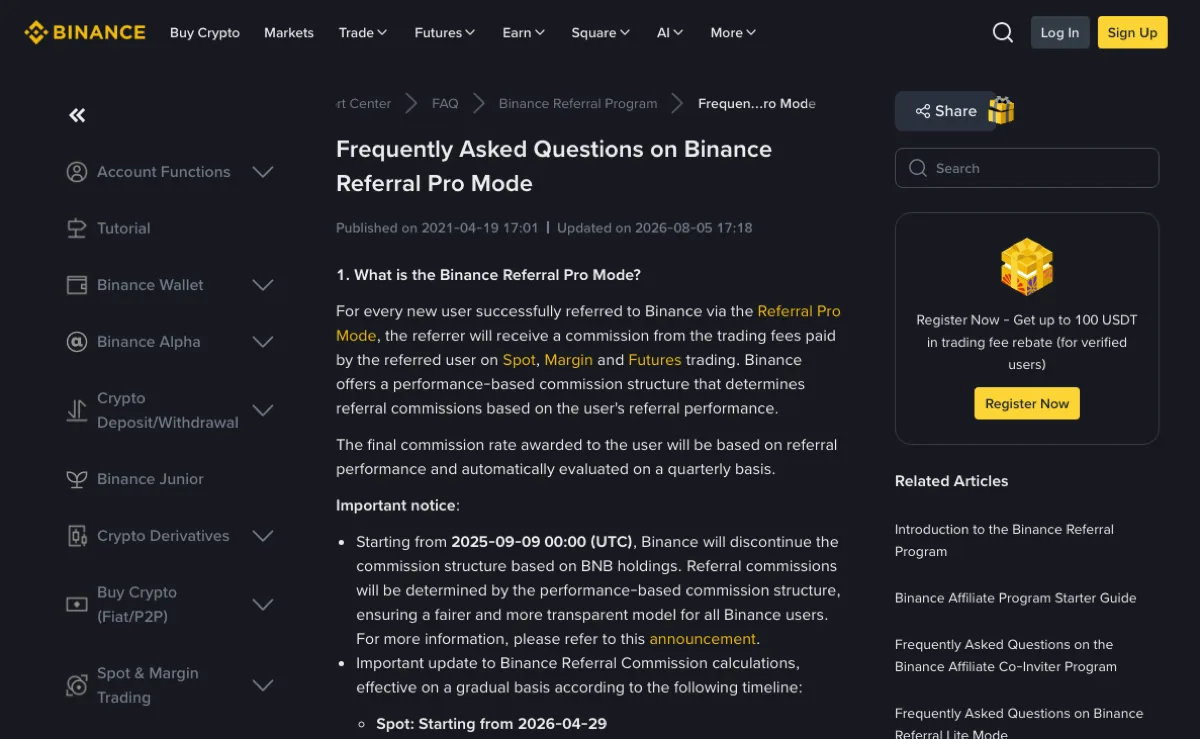
The official Referral Pro FAQ links to the later-binding page. Use those sources to check the account's eligibility.
Check all six later-binding conditions
The FAQ lists the following requirements together. The registration window starts when the account was created, not when you noticed the missing code.
- The user is within 30 days of registration.
- The account has no deposit or trading activity.
- There is no existing referral relationship.
- It is a parent account.
- The KYC information has not been used on another account within the past 180 days.
- The user is not flagged as a wash trader.
Check the account's actual records. The rule does not state a small-deposit exemption, and withdrawing funds later does not erase the deposit history. If the treatment of a particular record is unclear, ask official support rather than assuming it is exempt.
An existing account with trading history has a separate application route
Binance's Affiliate Rebind FAQ, published on 28 September 2026 and checked in October, distinguishes self-rebinding for users with no trading history from an application for users who have traded. For the latter, an Affiliate obtains a rebind link from the dashboard; the user follows it, reviews the details and confirms the application. The user must have completed KYC, have no existing referrer, use a master account, have traded less than 5,000 USD equivalent in the past 90 days, have no disqualifying activity flag and be outside restricted referral regions.
For that application route, the FAQ requires 150,000 USD equivalent in qualifying trading volume within 30 days of submission before the relationship is established. Check the current official page and account status for eligibility. Do not increase your trading just to reach that figure: fees and market losses can outweigh any later rebate.
If the binding page rejects the request
Save the message and compare it with registration, deposit and trading records. Repeated submission does not change a date or remove an existing relationship. If the reason is unclear, ask support about the specific condition instead of opening another account.
The FAQ says an established referral relationship cannot be changed or removed. It also explains that closing an account and opening another for referral benefits can result in commission termination. A promise from a person in chat cannot override those rules.
Keep confirmed and unknown results separate
| What you can see | Next step |
|---|---|
| A referrer is displayed | Check that relationship and its applicable terms. |
| No relationship is confirmed by the official flow | Compare all six later-binding conditions. |
| Page blank, entry missing or not signed in | Keep the result as unknown and verify through the official account. |
The referral-status checklist only organizes the answers you provide. It cannot read your account or create a relationship on your behalf.
Do not create another account to change the code
A second registration does not remove the previous identity and referral records. Apart from the referral rules, multiple accounts create more credentials and verification records to manage. Handle the existing account through the official process.
Verify the field before a new registration
If you have not registered yet, read the field labeled Invite, Referral or its translated equivalent before submitting. Paste the intended code into that field and check the characters. An email subject or support message does not substitute for the registration field.
After a redirect or change of signup method, recheck the final form rather than assuming the earlier value carried through. See the registration guide for the field sequence and fee explanation for the distinction between a rate and a rebate.