Cover for the Binance region-limit handbook, stepped bars
Handbook cover · Aug 2026

BORDER

When Binance will not load, or a region banner appears

  1. Read the words

    Region unavailable, network timeout, and a certificate error are three different jobs.

  2. Check the live notice

    Match it against the published service map, not a forum screenshot.

  3. Existing account

    If you can log in, read the asset rules first. If you cannot, do not hand the keys to a “helper.”

NOTE

HuiBonus does not teach you to evade a region gate and does not sell a “registerable route.” Region policy moves. A frozen country list goes stale.

Read the words on the screen first. A timeout, a certificate error, and a region-unavailable notice are three different jobs. Mix them and you will tap a clone.

Gu Heng can write how to read a page, and what not to do. He cannot write how to pretend you live in another country. This site does not provide a workaround.

Binance.com, Binance.US, the Japanese entity, and Gulf local licences are not one account book. A referral code filled in a banned-promotion region also may not pay commission. That is a second layer, separate from “does the page load.” Rules move. Trust the page in front of you.

Three kinds of “will not load” — do not treat them as one

Read the words on the screen, then pick the next step. Do not search “latest address” first.

Three kinds of will-not-load · different jobs
What you seeWhat it more likely isWhat not to do
Spinner forever, timeout, DNS failureNetwork or a local blockDo not edit hosts. Do not install an “accelerator package”
Invalid certificate, privacy error, a domain off by one letterA clone or a hijackDo not keep logging in. Do not type a password into the warning
Region unavailable, use the local entity, it looks like you are in XService scopeDo not force .com. Do not buy a “registerable route”

For a timeout, try another browser, drop extra extensions, and check whether the system clock is wrong. For a certificate error, look at the address bar. One extra letter or a hyphen is a fake. A region banner is product scope. Another browser will not walk through it.

When we walked the public pages, the region banner appeared before the form. It is not a load failure. Dismiss it and keep typing, and KYC can still stop you on residence.

The same sentence “cannot access” can come from a browser console, a system proxy, or a company firewall. That is local, not service scope. The crude test: change network, change device, see whether the words change. If they change, it is probably local. If the words stay, treat it as region.

A passport cover does not settle residence

Review looks at where you live, and it asks you to prove it. A passport only proves nationality.

Hold a passport from country A, with tax bills and a lease in country B, and you walk B. A short business trip, a family visit, or a transit visa does not make you a local resident. People think “I am in the airport, so I can open the local book.” Later the documents do not match, and the account gets flagged.

Dual nationality that fills the form as “both” is a stall of its own. Pick one jurisdiction you can prove you live in. Do not tick both. Proof-of-address windows vary by country. Recent bills are common. The review page wins.

Follow the page to the local entity. Binance.US is a different company. Do not treat the sheet as “refresh and .com will let you in.”

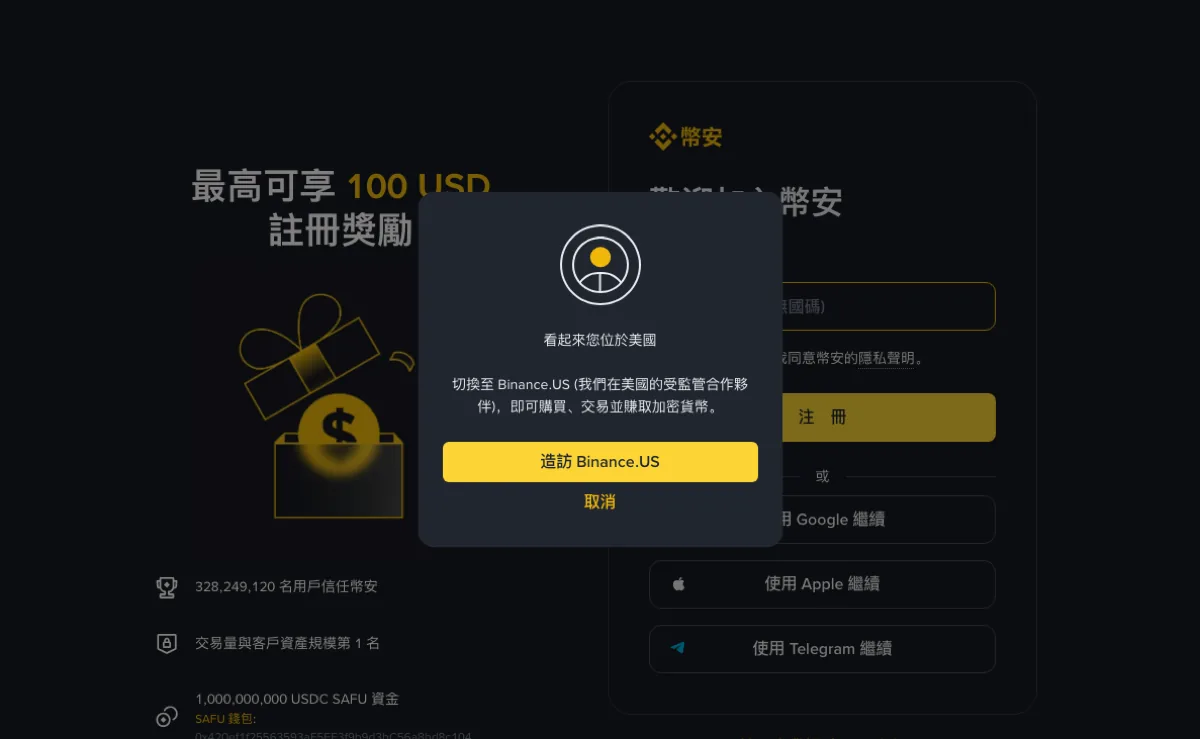
Signup banner saying it looks like you are in the United States, suggesting a visit to Binance.US
Captured Aug 2026. The capture environment was identified as the United States, so the sheet suggested Binance.US. The UI is in Traditional Chinese. Not every reader sees this exact sheet.

The body of that sheet said: switch to Binance.US, a regulated partner in the United States, to buy, trade, and earn crypto. The button was “Visit Binance.US.” It states the relationship clearly — a partner, not the same login.

A US resident opening on .com will usually fail compliance later. Funds, the product list, and support tickets are not shared. If you want the US entity, go to binance.us and follow that site’s own rules. This site’s referral code does not apply there.

The sheet can name another country. The reading is the same: it is telling you which entity to use, not testing whether you can close it.

Visit leaves .com. Dismiss only closes the sheet. It does not mean .com has started serving you. Our capture environment was identified as the United States, so Binance.US appeared. If your network is identified as another jurisdiction, the copy changes. Do not hold our screenshot against your screen. Different words are normal.

Dismiss keeps you on the page; Visit leaves

On the sheet we captured in August 2026, the main button was “Visit Binance.US.” Some languages write Visit. Next to it you can usually close the sheet, or see Cancel.

Visit: the browser leaves .com. The address bar becomes the US entity. The login box belongs to another company. A password and authenticator you set on .com do not travel. This site’s referral code dies here. Terms, KYC, and the product list follow .US pages. Browser Back may return you to the .com sheet. That is history, not a shared account.

Cancel or close: the sheet goes away. You are still on the .com signup or login page. The form may still sit there. The eligibility gate did not open. KYC still follows the residence you declare and can prove. When we checked public pages, closing the sheet still left input boxes visible, and review could still stop you on residence. Reading Cancel as “I am now allowed to open .com” is how people stall later.

People mash Cancel, switch browsers, and clear cookies until the sheet stops appearing. That only means this detection pass did not fire. Residence did not change. When the documents do not match, the account gets flagged. This site does not provide a workaround, and it does not write “change network and you will pass.”

On a hotel trip, Wi-Fi may raise another country sheet. Do not edit account details to “match” the banner. Residence is the address you can prove, not the hotel network. If you can already log in, leave KYC alone. If you have not opened yet, stop and read the entity page.

.com, .US, Japan, and the Gulf are not one firm

Different domains, different licences, different products. You cannot treat the accounts as one passbook.

.com serves international users, and the map shrinks by jurisdiction. The United States walks .US. Japan has long had a local licensed entity. The product list and fiat rails are not the .com menu. Several Gulf countries have local licences or partner arrangements. Documents and tradable products follow the local page. If a Thai user is steered to a local entity, do not insist on forcing .com.

This handbook does not print a “forever registerable country table.” Frozen lists go stale. What you check is: does the signup page in front of you accept your residence, and does the KYC list accept your document. Help centre and terms change. Follow the pages you open.

Japanese readers steered to a local licensed site follow local rules for fiat deposits, tradable products, and tax-report formats. Do not carry .com futures habits across. Gulf readers the same: listings and leverage caps on the local entity may not match the international book. Futures positions can lose 100%. If the local site offers derivatives, the risk notice is not looser than international.

The .US product list has long been narrower than international. What you can buy is only what binance.us lists. Copy a .com pair name across and it often does not exist.

Binance.US is not a reskin of .com

Two companies. Logins are not shared. Funds do not transfer internally. Support tickets do not cross. This site does not print licence numbers — numbers change, and a frozen print goes stale. What you check is the address bar, and the products that site lists today.

.com vs .US · dimensions (desk notes, August 2026; follow the page you open)
Dimension.com (international)Binance.US
Firm and loginInternational accountAnother company. Password and authenticator do not travel
PairsWhatever the international markets page listsA narrower list. A .com name often has no row
Fiat railsLocal fiat, P2P (C2C), and others, by residenceThat site’s own deposit page. A .com P2P (C2C) walkthrough will not find the door
DerivativesPerpetuals, options, and the rest follow the international product page; positions can lose 100%Do not assume the same futures book. The binance.us product page wins
Referral codeThis site’s BN5785 is only discussed on this sideDoes not apply. Filling it will not join the two ledgers
KYCInternational review pageEach side collects its own files. A pass on one is not a pass on the other

Failure shapes we have seen (no specific accounts): taking a .com P2P (C2C) walkthrough onto .US, not finding the door, and assuming theft; looking for an international futures contract on the Japanese local site, not finding it, then installing a third-party app. Neither is a glitch. The entity changed, so the menu changed.

The same email may start on .com, fail the region, then go to .US. Whether both firms allow the same email is whatever each signup page says. We do not freeze that here. Even if both open, funds do not move internally. You would withdraw on-chain and deposit again — if both sides allow withdraw and deposit, and the network is right.

Do not assume P2P (C2C), earn, or copy trading exist on both sides. Missing is missing. This site’s referral code does not apply to .US, and this region handbook does not put a coded registration link in the body.

An exchange is a company, not a protocol. Bitcoin.org describes Bitcoin as a peer-to-peer system: How does Bitcoin work. A balance on an exchange is a liability on that company’s ledger, constrained by where that company may operate. A chain address has no nationality. A company does.

Opening the same email on .com and on .US still does not move funds between them. A withdrawal is an on-chain transfer. You pick the network. That has nothing to do with whether the two firms are “one.”

New signup hits a region limit

Stop. Do not buy a proxy opening. Do not buy an “already KYC’d” account. Do not keep putting documents into a clone page.

A new signup that is blocked is usually residence outside that entity’s service map. Passport nationality and residence are not the same fact: hold a passport from A, live in B, and review looks at the residence you declare and can prove. Forged documents flag the account. They are not “fine once you pass.”

The only next step is: read the local entity the page names, or use another service your residence can legally use. This site does not rank which firm is “better,” and it does not pick for you.

Proxy openings, ready-made accounts, and KYC’d account sales leave your face and documents with the seller. Money can go in and still not come out. If it comes out, it can become a dispute under someone else’s name. That is a different problem from region limits, but they are often sold together: first “you cannot open there,” then the account.

A KYC bounce and a region limit sometimes stack. If the reject reason is a photo, fix the photo. If it says the region is unavailable, reshooting will not help. Photo problems are in when identity verification is rejected.

Is the banned-promotion list the same as this site’s invite code?

No. Banned promotion affects whether this site can earn commission. It is not your personal signup button. The two often overlap. Do not treat them as one table.

As of the affiliate program’s public limits checked in June 2026: the US and Canada, Singapore / Malaysia / Hong Kong / Japan, the Philippines, Thailand on .com, UK commissions paused, and most of the EEA sit in banned-promotion or paused-commission corridors. Workable-corridor examples: Australia and New Zealand, Indonesia, Vietnam, the Gulf, and Taiwan were not on that ban list at the time. France, Italy, and Spain were named as workable. The list moves. Check the signup sheet you actually opened.

If you live in a banned-promotion region, even a page that lets you open may not pay commission on this site’s invite code, and this site should not steer you to fill it. Coded registration links sit only in a few guides where the reader already intends to register and is more likely to sit in a workable corridor. This is a region guide. The body does not carry a coded registration link.

Living in a workable corridor still does not mean you can open .com. Eligibility follows entity rules. Commission follows affiliate rules. Two tables. Ask eligibility first, then the code.

UK commissions paused does not mean a UK resident cannot open any Binance-related account. That is affiliate-side pause. Eligibility is still the entity page. Most of the EEA sits in banned promotion, which is one cut of a wider tightening of who may operate in the EU. This site does not steer those regions to fill a code. Check the entity page yourself. Do not ask us for a “special route.”

Taiwan, Australia and New Zealand, Indonesia, Vietnam, and the Gulf were not on the June 2026 public ban list. That only says promotion could run then. Local law can still restrict you. The list is not a pass.

Read the two tables by corridor

Affiliate banned-promotion and signup eligibility are two tables. The corridors below follow the public limits we checked in June 2026. They only describe how promotion was drawn then. Whether you can open is still the signup page. Lists go stale.

Corridor notes · June 2026 affiliate public limits · not an onboarding whitelist
CorridorPromotion thenWhat to watch at signup
Australia and New Zealand, Indonesia, Vietnam, TaiwanNot on that ban list at the timeThe signup page still has to accept your residence. The list is not a pass
Several Gulf countriesNot on that ban list at the timeThe Gulf is not one country. UAE, Bahrain, and Saudi arrangements differ. Follow the local entity page
US / CanadaBanned promotionUS residents are steered to Binance.US. Canada should not assume .com works
Singapore, Malaysia, Hong Kong, JapanBanned promotion or the local-entity sideJapan has long had a local licensed site. HK / SG / MY should not treat last month’s forum screenshot as proof you can open now
United KingdomAffiliate-side commissions pausedPaused commission is not a dead account. Eligibility is the entity page
Most of the EEABanned promotionFrance, Italy, and Spain named as workable refers to promotion. Signup, fiat, and derivatives still follow the entity page
Philippines, Thailand .comBanned promotion or a local entityIf a Thai user is steered to a local entity, do not insist on forcing .com

How to read this table: find your corridor, then ask two questions — does the signup page let you open, and should this site steer you to fill a code. The first is the entity. The second is the affiliate. Both “yes” before you talk about a code. This is a region guide. The body does not carry a coded registration link.

Do not mix Taiwan and Hong Kong on the form. Passport, residence, and tax residence can be three answers. Answer the field that was asked. “Both” stalls review. Australia and New Zealand the same: they are not one local rulebook. They only sat in the same workable-promotion corridor at the time.

After Visit takes you to Binance.US, wanting a .com account anyway: changing the address bar back to international usually brings the sheet back. Do not read “I already saw the US site, so international should let me through.” Each firm reviews on its own. Documents, products, and referral codes are not shared.

A Canadian reader may not see the word “United States.” The sheet may name Canada, or it may say the region is unavailable. Same reading: follow the entity the page names. Do not force .com. This site’s code does not apply to .US, and this handbook does not put a coded link in the body.

When Japanese readers are steered to a local licensed site, bank lists for fiat, tradable products, and tax-report formats follow that side. An international perpetual-futures walkthrough often will not match the menu. A mismatch is not theft. It is a different entity.

Another failure shape: you live in a workable corridor, you are travelling, hotel Wi-Fi opens the signup page, and the sheet follows the hotel’s country. People then edit the residence field to “match” the banner, and the documents fail when they go home. Fill residence with the address you can prove, not with Wi-Fi. The sheet only says where this detection pass put you. It is not asking you to change identity.

Indonesian and Vietnamese readers who can walk .com on the signup page may still face another set of local fiat and tax-filing rules. This site does not rank local compliance, and it does not fill forms. Gulf readers who read “workable corridor” as “every Gulf country can open .com” will miss. The local entity page wins.

US / Canada, SG / MY / HK / JP, and the UK corridor are where search results sell “registerable routes” the hardest. That is a clone and malware cluster. This site does not provide a workaround. If the page will not load, the app is missing from the store, or a banner steers you to a local entity, follow the prompt. Do not hunt another entrance.

Corridors move. The June 2026 public limits are what we could check then. France, Italy, and Spain named as workable does not freeze signup rules in those three countries. UK commissions paused does not auto-void an existing account. Read the banner on your own login.

What an existing account can still do

If you can log in, read in-app notices and whether withdrawals are still allowed. If you cannot log in, do not hand a seed or a code to a “helper.”

When policy tightens, the common path is: stop new signups, then fiat, then derivatives, and only later spot and withdrawals. There is no shared timetable. If you can still see a balance, read the network and limits on the withdrawal page, and follow that page. A wrong-chain loss may not come back. That is another handbook.

Leveraged and futures positions can lose 100%. During a region-policy shift, futures may close first. Do not add leverage for “one last trade.”

People move countries. Residence changed, so KYC may ask for a fresh proof of address. That is not a glitch. Follow the review page. Do not lean on an expired bill from the old address.

If an existing account still allows withdrawals, check the network name and the address before you ask whether you can still trade later. A wrong-chain loss may not come back. If you can log in but cannot place an order, read in-app notices first. Do not tap a search-ad “migration channel.”

If the authenticator and the inbox still work, the account still has keys. Handing both to a “helper” is handing the keys over. Tickets go through the help entry inside a logged-in session.

The app is missing from the store

Store listings and web signup are two rulebooks. If the app is missing, try the web. Do not install a third-party package.

Apple and Google stock shelves by account region. A store account in country A and a person in country B often see different results. This site does not ship APKs and does not offer “enterprise signing.” That channel is a malware cluster. More on the app side is in app availability by store region.

If the web opens and the app does not, finish verification and security on the web first. The authenticator lives in its own app. It does not need the exchange app to be listed.

Third-party “cracked” or “enterprise-signed” pages often pair with a fake login. After install, a verification prompt in the notification tray may not be one you tapped. This site does not ship any installer, and it does not rank which third party “works.”

Words clone pages love

Phrases like “latest entrance,” “official verification channel,” and “emergency migration,” in search ads and DMs, should be treated as fake first.

An exchange will not “pass your KYC” inside a random link. It will not “protectively move” funds because you tapped a search ad. Investopedia’s general note on how Bitcoin works is How Bitcoin Works; the protocol is the chain, phishing is people. On the people side, the address bar beats an ad graphic.

Ethereum accounts are key-controlled. The explainer is ethereum.org · wallets. Hand a code to fake support and you hand over the exchange account. Hand a seed and the on-chain assets may go too. Two sets of keys. Do not hand both.

Search ads buy brand terms. The first two results are often not the entity you meant. Read the spelling in the address bar. Do not read the logo on the ad graphic. A bookmark you saved yourself is safer than searching every time.

The “restricted jurisdictions” list in the help centre and the terms does not fully overlap the affiliate banned-promotion list. The first decides whether you can open or keep using. The second decides whether promotion pays. Both lists move. What we checked in June 2026 is affiliate-side public limits. It is not an onboarding whitelist, and it is not a promise it still holds today.

If you have read the words and still cannot decide, stay inside the logged-in help centre. Do not open a string of new search tabs. Clone density rises in those extra tabs. The only next steps this handbook can give: follow the entity, withdraw against notices, and do not hand a code to a third person.

A stablecoin on a platform ledger is still that company’s liability. Tether discloses reserves by chain at tether.to/transparency. If region policy limits withdrawals, a number on the ledger is not the same as an on-chain send you can make now. Read whether the withdrawal page lets you tap, then talk about the next step.

France, Italy, and Spain named as workable on the June 2026 affiliate list does not freeze signup rules in those three countries. Workable is the promotion side. Signup, fiat, and derivatives still follow the entity page and local regulation. UK commissions paused is affiliate-side pause, not an automatic “account void.” Existing accounts follow notices.

The Gulf is not one country. UAE, Bahrain, and Saudi operations differ. “Gulf is workable” is not “every Gulf country can open .com.” Follow the local entity page. This site does not print a country list as a permanent answer.

When the Philippines, Thailand .com, Malaysia, Singapore, Hong Kong, and Japan sit on banned promotion or the local-entity side, the common next move is to search “can I still use it.” The first results often sell routes. Stop. Read the signup page and the help centre in front of you. Do not read last month’s forum screenshot.

A different region banner on a trip is not a reason to edit account details to “match” the sheet. Residence is the address you can prove, not hotel Wi-Fi. If you can log in, leave KYC alone. If you cannot, use the help centre. Do not install a new “region pack.”

If the web opens and the app will not install, prefer the web. API, withdrawals, and verification all live there. No app is not no account. The reverse is also true: an app in the store does not mean your residence may open .com. Store listings and operating scope are two books.

On a certificate error, check the system clock and whether a company proxy is intercepting. Proceeding hands the password to a middle box. We stop on a certificate warning and try another network. If the warning stays, treat it as a fake. We do not click Advanced because we are in a hurry to log in.

This handbook does not put a coded registration link in the body, and it does not steer you into the signup walkthrough. A region piece’s job is to read the prompt, name the entity, and stay off clones. If eligibility still clears and you have decided to open, use another handbook. Here, split the three kinds of “will not load.” Do not treat them as one.

What this site could check is the June 2026 affiliate public limits and the August 2026 signup sheet identified as the United States. Both go stale. The words on your screen are newer than this capture.

This site is not Binance. The commercial relationship is on the disclosure page. Loss language is on the risk notice. If we got a fact wrong, see corrections.

The page says it looks like I am in the United States. What now?

Follow the page to the local entity. Binance.US is a different company. Do not force .com.

Can a US resident use Binance.com?

The page steers you to Binance.US. Accounts, compliance, and the product list are not shared.

Does this site’s invite code still help in a banned-promotion region?

Affiliate-side commission may not pay. Whether you can open an account is still the signup page. Do not treat the two tables as one.

Can I change network environment to open an account?

Do not operate on that idea. This site does not provide workarounds. Review still looks at residence and documents.

If I dismiss the banner, does .com start serving me?

No. Dismiss only closes the sheet. The eligibility gate and review still follow residence. Visit leaves .com.