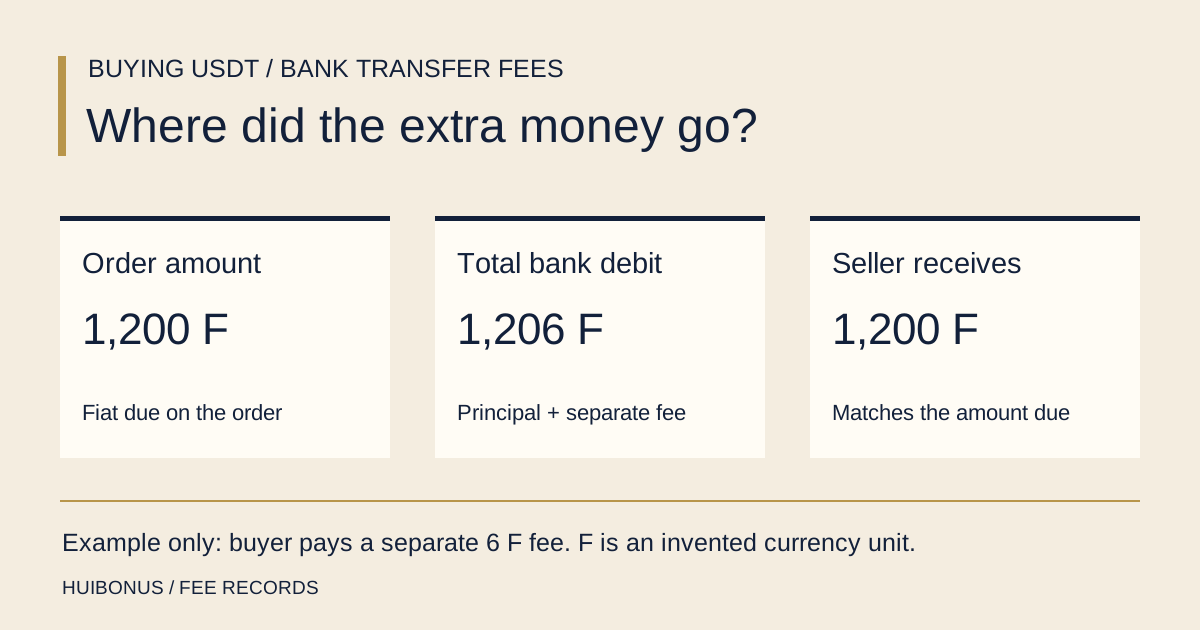
Public sources checked on 13 September 2026. On Binance P2P (also called C2C), the bank transfer fee is paid by whichever side the market rules or a clear pre-trade agreement assign it to. For RUB, UAH, KZT, IDR and BDT orders that is the buyer, and the seller must receive the full amount. In other currencies, each side covers its own extra transfer costs unless both agreed otherwise. A bank charge is separate from the platform trading fee.
So when your bank shows the money has gone but the seller says the payment is short, the starting point is the payment breakdown, not the USDT price. A successful bank debit does not by itself mean the purchase is complete, and nothing here can settle a dispute on your order.
Agree on the amount due, not just “fees included”
The English Binance P2P User Transaction Policy states its scope as makers, takers and verified non-CN users. Its general fee clause allows an explicit pre-trade agreement allocating additional transfer costs to one party and says payments must account for those costs. It does not prescribe a fifty-fifty split.
For RUB, UAH, KZT, IDR and BDT transactions, that clause specifically places payment-provider transfer fees on the buyer and requires the seller to receive the full amount. This is the scope of a rule, not a list of markets currently available to you. Ad terms cannot override platform policy.
The Simplified Chinese page is a different C2C rulebook, marked as applying only to the CNY trading zone; the Traditional Chinese page is a translation of the global policy. Do not treat the Simplified Chinese version as interchangeable with the rules for another market. Changing the interface language does not change the rules or eligibility attached to an order. Ask platform support which terms apply if that is unclear.
“Fees included” leaves room for two different readings: the buyer means the total leaving their bank; the seller means the amount arriving in theirs. Before paying, make the distinction explicit in the platform chat: “Does the full fiat amount on this order need to arrive in your account? Who covers the payment provider’s charge, and where is it deducted?” That gives both sides something specific to check later.
One order, two ways to deduct the same fee
Here is an invented example, not a bank quote. F is a fictional fiat unit. The order is for 1,200 F; the applicable conditions require the seller to receive 1,200 F; and the buyer bears a 6 F transfer charge. Assume no other charges or currency conversion.
| Record | Fee charged separately | Fee taken from the total sent |
|---|---|---|
| Total bank debit | 1,206 F | 1,200 F |
| Transfer fee within that debit | 6 F | 6 F |
| Seller receives | 1,200 F | 1,194 F |
| Difference from the order amount | 0 F | 6 F short |
In the first case, the extra 6 F pays the provider. It buys no additional USDT. In the second, a debit of 1,200 F is real, but it is not evidence that 1,200 F reached the seller. The difference comes from how the fee is deducted, not from the ad’s minimum and maximum order limits.
Do not read the example as an instruction to type 1,206 into a transfer form. The amount field might mean the principal, the total you will pay, or the expected amount received. Read the confirmation screen before doing the arithmetic. Adding a fee to the principal when the bank already charges it separately could count the same cost twice. A receiving-side charge would need its own line too.
If the currencies differ, pause the subtraction. Match the provider’s conversion record to the amounts first, so a currency conversion difference does not get mislabeled as a bank fee.
A cheaper-looking payment route is not a reason to change the agreed method mid-order. Keep the payment consistent with the order conditions; otherwise there may be a payment-method dispute as well as an unexplained fee.
The P2P fee page answers a different question
Binance’s introduction to P2P trading distinguishes platform charges on completed orders, which can vary by market and apply to makers or takers, from additional payment-provider charges. An old “zero fees” guide therefore tells you nothing about the cost of your bank transfer.
For the platform charge, open the official P2P fee page. Look for the Fiat and Trade Zone selectors and the prompt to log in for account-specific rates. Match the market, zone and coin to the order you are checking. The bank’s fee still belongs in the bank or payment-provider records.
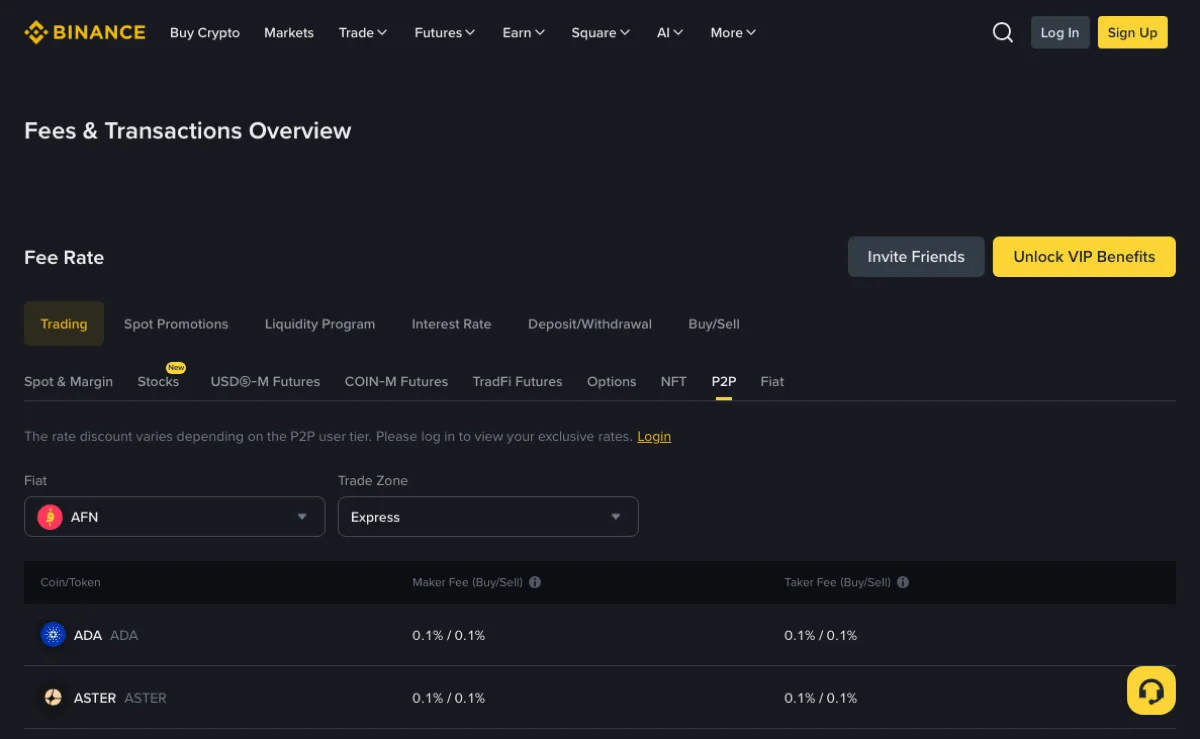
Keep two cost lines: platform trading fee against the platform order; fiat transfer fee against the payment receipt. If the USDT received differs from what you expected, check the platform’s asset, quantity and fee entries as well. Extra fiat debited by a bank cannot, by itself, explain missing USDT on the platform. Those units cannot be subtracted from each other.
A short payment needs a matching record
The English policy’s seller instructions require transaction proof showing the deduction when a payment provider charges extra fees. “Less arrived” and “the provider took the difference” are separate claims.
For an unexplained difference, gather the records that belong to this order:
- Order currency and fiat amount. This is the payment baseline. An earlier ad quote is not a substitute.
- The payer’s receipt. Identify principal, fee, total debit and completion status where the receipt shows them. Leave a missing field unknown.
- The recipient’s record. Match the credit and any deduction to the same transfer. A similar amount from another payment does not explain this one.
- The fee agreement. Keep the pre-trade ad conditions and platform conversation that establish which party was to cover which charge.
Suppose your receipt gives only a total debit and the seller’s record gives only a credit. You can see a difference, but you still cannot label it confidently. Explain the missing information through official platform support and ask the payment provider about its own deduction. Do not invent a fee amount to make the two records balance.
These records help locate the discrepancy; they do not guarantee a refund or recovery. Whether anything must be topped up, and how, needs to be resolved against the original order, applicable rules and clear records. A demand for an “unfreezing fee” or payment to a new account is a reason to stop and use platform support. The P2P payment safety guide covers other warning signs.
For the purchase sequence, see buying USDT on P2P. For the bill in front of you, the narrower question remains: who received the difference, and where is it recorded? If that line is missing, keep the issue with the original order while it is clarified.
Does a referral discount cover my bank transfer fee?
No. A referral rebate relates to exchange trading fees and is credited later in USDC; it has nothing to do with what your bank charges. Check the payment provider’s fee terms and the receipt for this transfer.