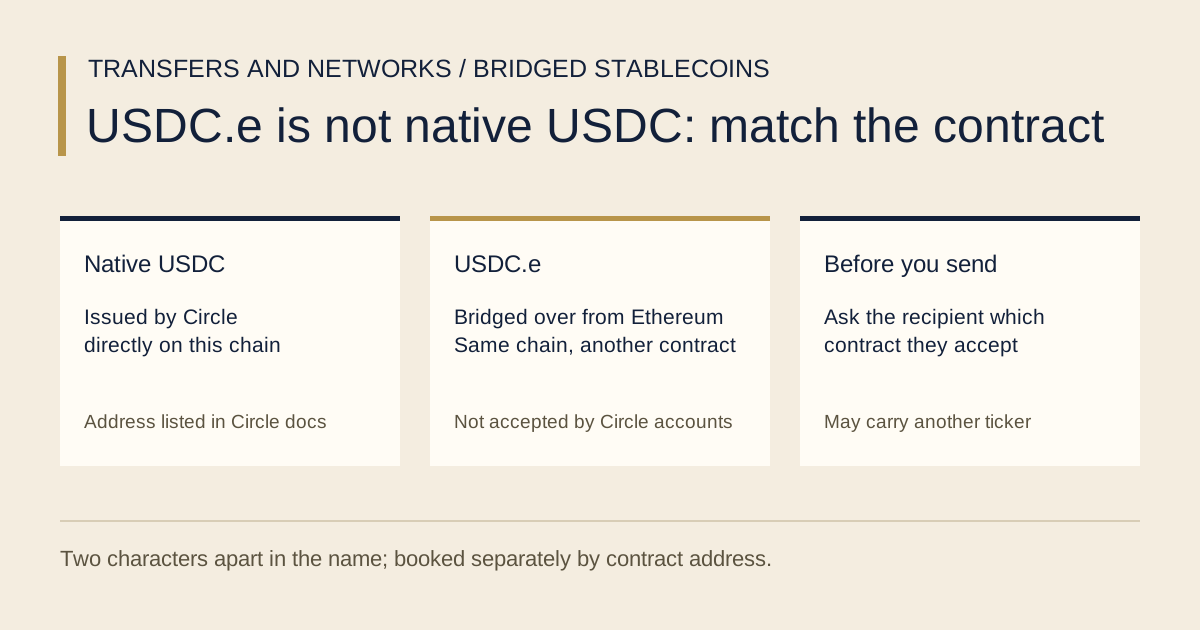
Say a wallet holds 500 USDC.e and the plan is to send it to Binance. Don't book that as 500 USDC yet. The deposit page has to support this exact contract on this network, and once the money lands it may sit under a different ticker. That one line decides whether a conversion still stands between you and USDC you can actually use.
USDC.e, as used here, is the version bridged across from Ethereum. Native USDC is issued on the destination chain by Circle itself. On a single chain they are two separate contract addresses, and exchanges and recipients keep their books by contract, not by name. What you match before sending is the address string. The four letters prove nothing.
USDC.e vs native USDC: who issues it and who redeems it
Circle has a blog post on exactly this, Understanding USDC on Avalanche vs. USDC.e, published in December 2021. It describes USDC.e on Avalanche as a bridged form of Ethereum USDC, brought over through the Avalanche Bridge, and therefore not the same asset as native USDC.
The next few lines are the ones that cost money. Circle's products do not support USDC.e. It cannot be sent to a Circle deposit address, and it cannot be placed in a Circle account and redeemed for fiat. To get back to fiat that way, the USDC.e first has to go back over the bridge to Ethereum, where it becomes native USDC on Ethereum, and carry on from there.
That route is specifically about Avalanche USDC.e and redemption through a Circle account. Swapping to native USDC on a platform that accepts the bridged version is a different route with its own conversion cost, so bridging back to Ethereum should not be read as the only exit for every bridged token.
Circle's developer documentation takes the same line in its USDC contract address table: one address per chain, the native one. Under the table is a note on X Layer saying that chain also has a bridged version labelled USDC.e, which Circle neither issues nor backs, and that integrations should use the address in the table.
How to tell USDC.e from USDC on the same chain: match the contract address
Names won't settle it. Binance's October 2023 Polygon announcement gives the bridged version's full name as "USD Coin (PoS) (USDC.e)"; the Arbitrum one calls it "USD Coin Bridged (USDC.e)". Same kind of token, a different label on each page, and what a wallet chooses to display is less reliable still.
The contract address is the only thing you can check against. Across several announcements in October and November 2023, Binance listed both contracts side by side for three networks:
| Network | Native USDC contract | Bridged USDC.e contract | Bridged ticker on Binance |
|---|---|---|---|
| Arbitrum | 0xaf88…5831 | 0xff97…5cc8 | ARBUSDCE |
| Optimism | 0x0b2c…ff85 | 0x7f5c…1607 | OPUSDCE |
| Polygon | 0x3c49…3359 | 0x2791…4174 | MATICUSDCE |
The three native addresses in the second column are the same strings as the Arbitrum, OP Mainnet and Polygon PoS rows in Circle's table.
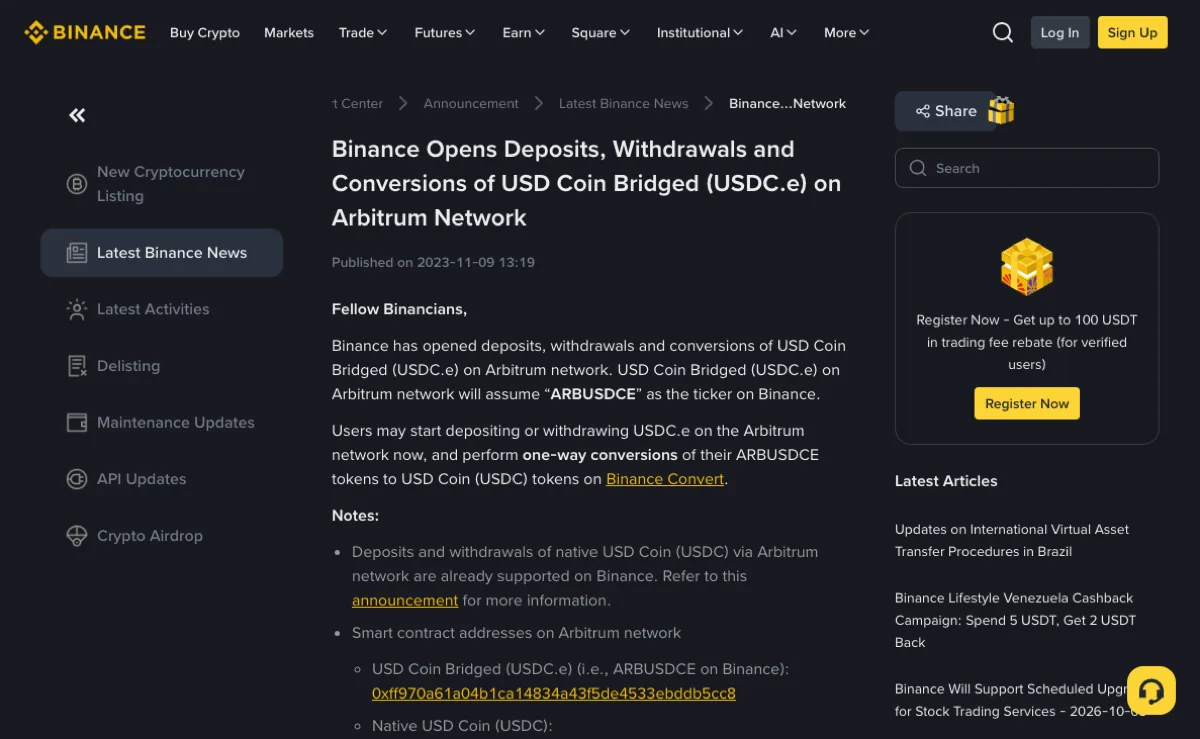
To find out which one you hold, pull the contract address of the token in your wallet. Open the token's detail screen and look for the contract line, or paste your own address into that chain's block explorer and see which contract the token holding links to. Then compare it with the two columns above. A match on the first and last four characters is not a match. Every character in between has to agree.
Will a USDC.e deposit be credited on Binance, and under which ticker
Back to the 500 USDC.e, this time on Arbitrum.
Binance's announcement of 9 November 2023 opened deposits and withdrawals of USDC.e on Arbitrum, gave it the ticker ARBUSDCE on Binance, and said users could make one-way conversions of ARBUSDCE to USDC on Binance Convert. It notes that deposits and withdrawals of native USDC on Arbitrum were already supported. The Optimism announcement of 25 October 2023 is written the same way with the ticker OPUSDCE. On Polygon the bridged version is MATICUSDCE; the 26 October 2023 announcement says it can be deposited to a Binance account and then swapped for native USDC through Convert.
For this one transfer, that leaves three lines to cost out.
- On Binance it isn't called USDC. Going by the announcement, the 500 belongs under ARBUSDCE. To use it as USDC, whether to trade it into something else or to withdraw on a different network, a Convert step sits in between.
- Convert runs one way. Both the Arbitrum and the Optimism announcements say "one-way" conversion to USDC. Once converted, there is no route back to the bridged token here. If the recipient asked for USDC.e by name, don't convert first.
- The announcement states no rate. What you receive depends on the Convert quote at the time, and the cost of getting in and getting out comes on top.
Those announcements date from 2023, so whether the door is still open needs its own check. Searching "USDCE" on Binance's public Deposit & Withdrawal Status page in October 2026 returned three rows, OPUSDCE, MATICUSDCE and ARBUSDCE, each reading Normal in both the deposit and the withdrawal column. That was the status at that moment. Run the search again before you send; the guide explains how to read the status when you see deposits suspended on a network.
What about USDC.e on other chains
The table covers three networks. It says nothing about USDC.e anywhere else. If your bridged token is on another chain and neither the deposit page nor the status page shows a matching coin and network, stop there and ask the platform's support before anything moves.
Binance Support's article "Why Hasn't My Deposit Been Credited?" has a section headed "You deposited an unlisted token or via an unsupported network". It asks you to confirm on the Deposit & Withdrawal Status page, before depositing, that Binance supports both the token and the deposit network, and warns that assets deposited the unsupported way may be lost with no means of recovery.
The trap is that a successful transfer on chain and a credit on the platform are two separate events. If the token contract lets you send to that 0x address, the block explorer can show success while the platform does not support that contract at all. A correct address is not the same as a correct token, which is the point of does a 0x address mean ERC20. If the transfer has already gone, work through the order in sent crypto on the wrong network.
Withdrawing USDC from an exchange to these chains: which one arrives
The other direction needs the same check. The announcements above are plain about it: choose USDC as the coin and Arbitrum or Optimism as the network, and what moves is the native token. The bridged version has its own ticker. So a withdrawal from Binance set to USDC on Arbitrum delivers the native contract.
A recipient that only takes USDC.e will not be able to match a native transfer either. Ask them for three things before sending: the network, the contract address and the minimum amount. "USDC on Arbitrum" is not an answer, because both contracts fit that sentence. The questions are laid out one by one in matching the receiving network for a stablecoin transfer.
The contract behind a coin name can also be replaced, and USDT is a recent example. Binance's announcement of 18 September 2026 says the USDT contract swap on the Optimism network is complete: users can deposit old Optimism USDT (OPUSDTE) and swap it for new Optimism USDT at a ratio of 1:1 using Convert, and withdrawals of OPUSDTE will no longer be supported. For a stablecoin that has sat untouched on a chain for a long while, read the receiving platform's recent announcements before sending and see whether the contract on that network has been replaced.
Already holding USDC.e: the fees on each route to native USDC
If the recipient only takes the native version, a conversion is unavoidable. There are three routes, and the fee lines differ on each.
- Deposit it to an exchange that accepts it, then convert. You pay the network fee to get it there, in that chain's native coin, then whatever gap the Convert quote shows, plus a withdrawal fee if it has to go back on chain afterwards.
- Swap it on chain in a swap app. The cost is the network fee plus the swap's own fee and slippage, and the amount you receive is whatever the quote says before you confirm.
- Bridge back to Ethereum. This is the route Circle's blog post gives for USDC.e on Avalanche, and what arrives on Ethereum is native USDC. The fee lines are whatever that bridge's page lists, and moving it on from Ethereum means paying a network fee in ETH.
On a small amount, work out the share first. Suppose the network fee, the conversion gap and the withdrawal fee, each converted to dollars at its own coin's price, add up to 1.50 dollars. On 500 dollars of principal that is 1.50 ÷ 500 × 100% = 0.3%. On 20 dollars it is 1.50 ÷ 20 × 100% = 7.5%. Same fees, and on the small amount they bite.
If the recipient already accepts USDC.e on that chain, there is no reason to pay for an extra conversion into the native version; a straight transfer can still carry a network fee or an exchange withdrawal fee. Whether to convert comes down to which contract the other side accepts.
If my wallet shows the name USDC, is it definitely the native version?
No. The name a wallet displays does not tell you which contract it is. Find the contract address on the token's detail screen or in a block explorer and compare the full contract address with the contract address published by the recipient; if the addresses differ, it is a different token.
After converting USDC.e to USDC on Binance, can I convert it back?
Binance's announcements describe a one-way conversion: USDC.e to USDC only. Confirm which contract the recipient accepts before converting; if they want the bridged version, leave the USDC.e as it is.