You press Withdraw and the page hands the amount straight back: below the minimum. You round the number up and it goes through. The second attempt actually leaves — the hash is right there on the explorer — and the balance on the other side does not move.
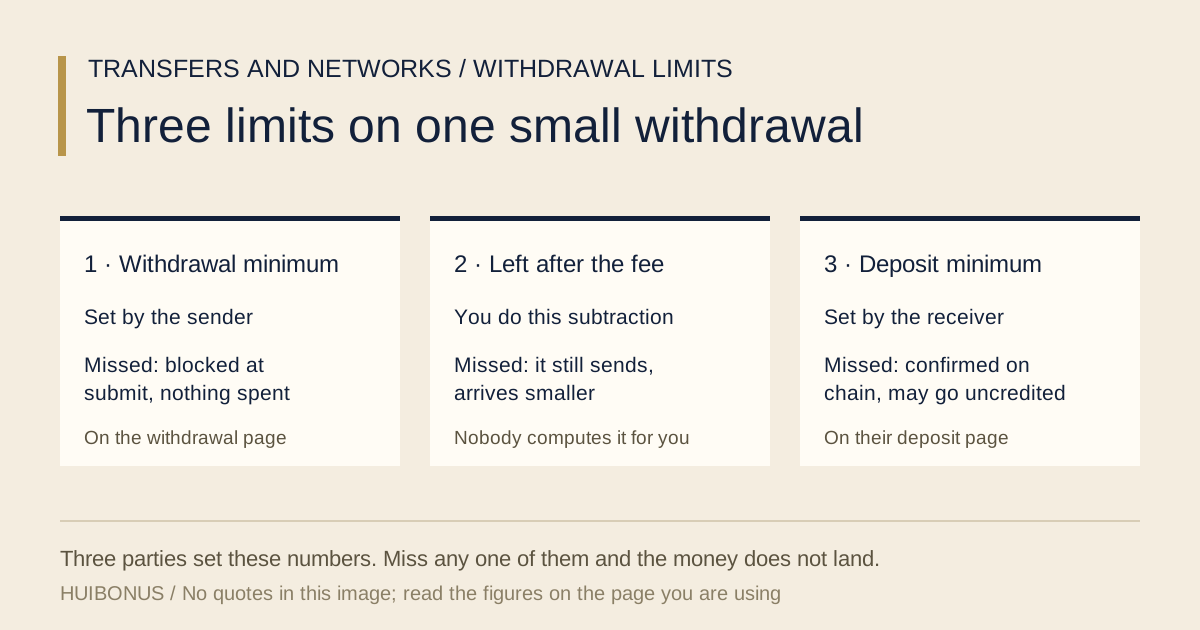
Those two failures are not the same failure. A small withdrawal has to clear three separate limits: the minimum the sending platform will let you send, whatever is left once the withdrawal fee comes off, and the minimum deposit the receiving side is willing to credit. Three numbers, set by three different parties, printed on three different pages. Miss any one of them and the money does not land.
Here they are in the order you actually meet them.
Where each of the three numbers is written
Binance puts most of this on one public page, its crypto deposit and withdrawal fees page. Under Fee Rate, the Deposit/Withdrawal tab lists each coin with one row per network, and the columns run Minimum Deposit, Minimum Withdrawal, Deposit Fee, Withdrawal Fee. Four columns, four different things. Reading across the wrong row is the common mistake here, and the rows are close together.
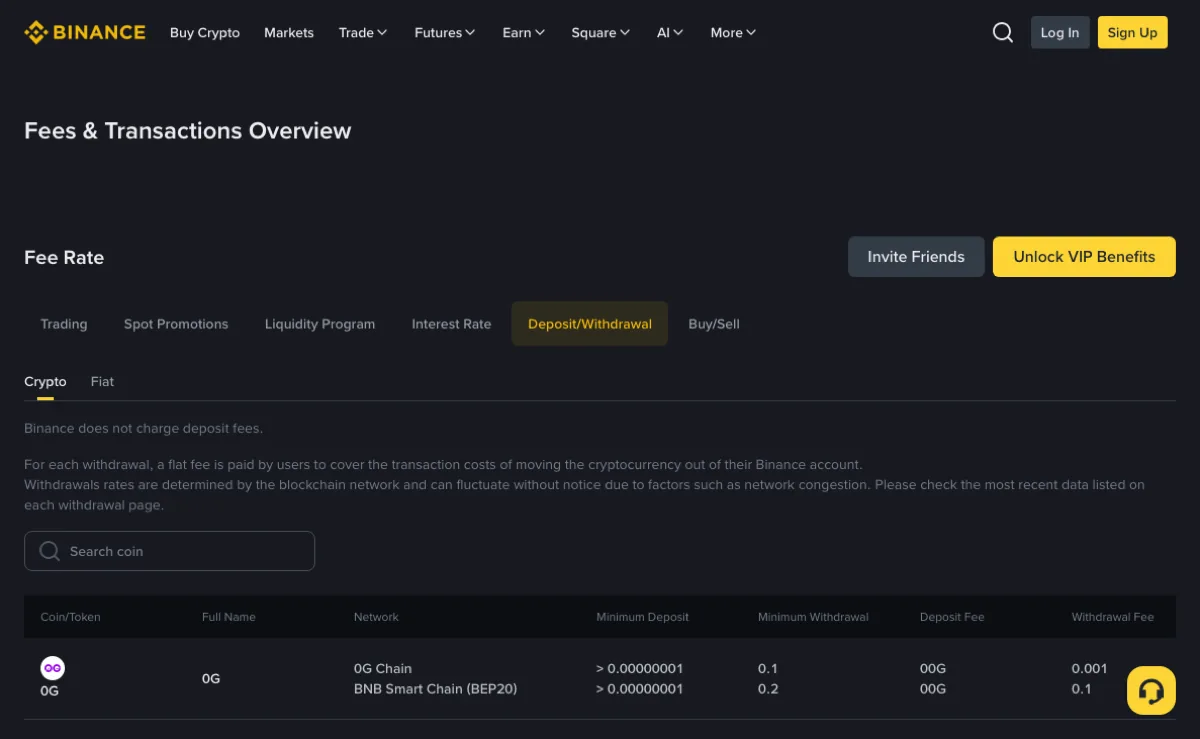
Two sentences on that page are worth copying into your notes. One: Binance does not charge deposit fees. The other: for each withdrawal a flat fee is paid by users, covering the transaction cost of moving the crypto out of their Binance account. The fee in front of you belongs to money leaving, not money arriving.
The same page adds a warning. Withdrawal rates are determined by the blockchain network and can change without notice when the network is congested, so the figure to trust is the one on the withdrawal page at the moment you send. Use the table to learn which columns exist. Do not use it to memorise a number.
The minimum withdrawal applies to the figure you type
Type less than it and the page refuses. Nothing is spent, nothing touches a chain, and there is no record to chase later — you have lost a minute, that is all.
Note that this number follows the network rather than the coin. Same USDT, different network, and both the minimum and the fee have to be read again for that network. An amount that went through on one chain last month can sit under the floor on another one today.
After the fee, the other side sees a different number
The second limit is not printed in any column, because it is arithmetic, and the arithmetic depends on which number you typed. Binance's withdrawal page takes the amount two ways. Enter a receive amount and the fee is added on top, so what you typed is what arrives. Enter a withdrawal amount and the fee comes out of it, so the remainder is what travels. Either way, take the estimated amount the page says will arrive, because that is what the receiving platform measures against its own rules.
| Limit | Set by | Where to read it | If you miss it |
|---|---|---|---|
| Minimum withdrawal | Sender | Withdrawal page; public fee page | Blocked at submit; costs nothing |
| Left after the fee | This transfer's fee | Withdrawal page, this transfer | It sends; less arrives |
| Minimum deposit | Receiver | Their deposit page | Confirms on chain; may not credit |
The combination that hurts is this one: you enter a withdrawal amount, it clears the withdrawal minimum, then the fee comes off and drops it under the receiver's deposit minimum. Every screen on your side is green. The transaction confirms. Nothing appears in the balance at the other end.
This is also where cost stops being abstract. Divide the fee by the amount you expect to receive and that percentage is what the transfer cost you. The same fee against a smaller arrival looks worse every time.
A rough rule that works: if what would land is less than ten times the fee, leave it and wait until there is more to send. It is a preference, not a rule. When the money is needed now, you accept the ugly percentage and get on with it.
Waiting has its own price. Coins parked on an exchange stay inside that platform's risk controls and eligibility rules for as long as they sit there. Whether a few extra days of that is worth the fee you saved is a judgement call, and it is yours.
If the withdrawal page shows a network as suspended, wait rather than reaching for another chain just to get the transfer moving. Switching networks only makes sense when the receiver accepts that chain and has given you a deposit address on it.
The third limit lives on the other side's page
You cannot look this one up from where you are standing. If the receiver is another exchange, its deposit page states a minimum deposit, and anything under that can confirm on chain and still stay outside your balance until a human deals with it. If the receiver is a wallet you control, there is usually no minimum of this kind, but there may be other conditions — on most networks you need some of the native coin sitting in the account before you can move the token at all.
Which means the reflex of sending one dollar first as a test needs adjusting. The test amount is not yours to pick; it comes from the number on the receiver's deposit page. Choose it too low and the test fails on its own terms, and you will read that failure as a bad address or a wrong network and start repairing things that were never broken.
When you cannot find the number and cannot get an answer, do not send. Get the network name and the minimum deposit confirmed in writing first, then decide the amount. The row-by-row check of network and address is in choosing a withdrawal network; how the chains differ on cost and speed is in USDT on TRC20 or ERC20.
Between accounts on the same platform, these limits do not all apply
When both sides sit on the same platform and the money moves internally, nothing goes through a public chain, so there is no block transaction cost to deduct. The limits and the crediting conditions are whatever that platform sets for itself. The difference is laid out in internal transfer versus an on-chain send. Do not carry the feel of an internal transfer across to a withdrawal, or the other way round.
What to keep once it stalls
Three kinds of failure, three different things worth saving. Blocked at submit: the wording of the message and the amount you tried. Nothing reached a chain, so there is nothing else to look up.
Sent but not credited is the one that needs a proper record. From the withdrawal history, keep the coin, the network name, the receiving address, the amount withdrawn, the fee and the transaction hash. Look that hash up on the explorer for the network you actually used, confirm the transaction itself succeeded, then hold the amount that arrived next to the receiver's minimum deposit and see which side of it you are on.
If it landed under the floor, resist sending a second small amount to top it up. That transfer has to clear the same three limits, it will probably fail in the same place, and it costs another fee on the way. Take the hash and the amount to the receiving side and ask how they handle deposits below the minimum.
People do ask whether two transfers to the same address can be added together to get over the line. Crediting is normally judged per transaction, two small deposits are not merged for you, and the receiver's rules are the ones that count. Ask before you send instead of assuming.
Keeping the record pays off a second time. Before you withdraw the same coin on the same chain again, pull up the last one and read the fee you paid and the amount that arrived. You will carry the order of magnitude in your head and stop recalculating from nothing. The figures still move, sometimes a lot when a network is congested, so treat the old record as a reference and read the fee and minimums fresh for every withdrawal.
If you would rather walk through networks, fees and crediting conditions in one pass, the network chooser asks the questions in order. It arranges the conditions for you; the limits that count are still the ones on both pages at the time you send.
Is the minimum withdrawal the same number as the minimum deposit?
No. The sending platform sets one and the receiving side sets the other, each on its own page, and the two figures need not match.
The amount arrived below the receiver's minimum. Is the money gone?
The on-chain transaction normally stands and the coins are at that address. Whether it is credited to your balance there depends on the receiving platform's rules, so contact them with the hash and the amount received.