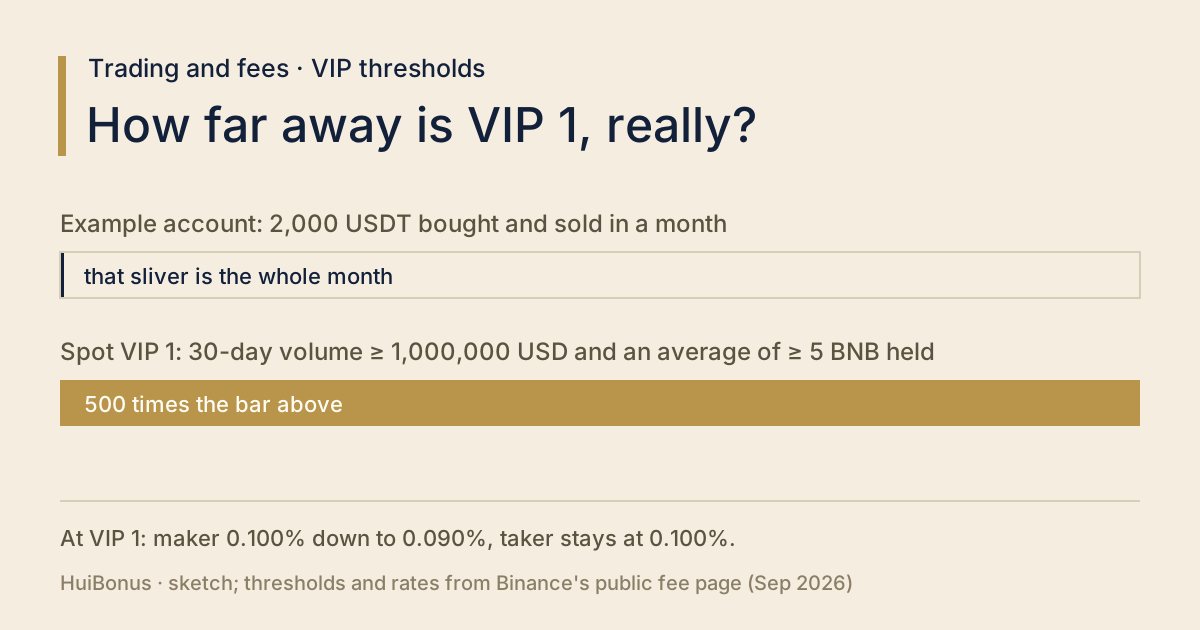
Put a number on it first. Say you buy and sell 2,000 USDT of spot in a month. As a regular user you pay 0.100% whether your order makes or takes, so the month costs you 2 USDT in fees. Turn on the BNB discount, which takes 25% off, and it is 1.5 USDT.
Spot VIP 1 asks for at least 1,000,000 USD of trading volume over the past 30 days. Call 1 USDT roughly a dollar and that is 500 times what this account trades in a month. Even if you got there, VIP 1 trims the maker fee from 0.100% to 0.090% and leaves the taker line exactly where it was. So "how do I get VIP" is usually the wrong sum to start with. The one worth doing is: at the volume you actually trade, where else can the fee come down, and what is that in dollars?
Two things to read on the VIP rows
The thresholds and the rates are both on Binance's public Fees & Transactions Overview page, and you don't need to log in to see them. Click [Trading], then [Spot & Margin]. The first four rows look like this:
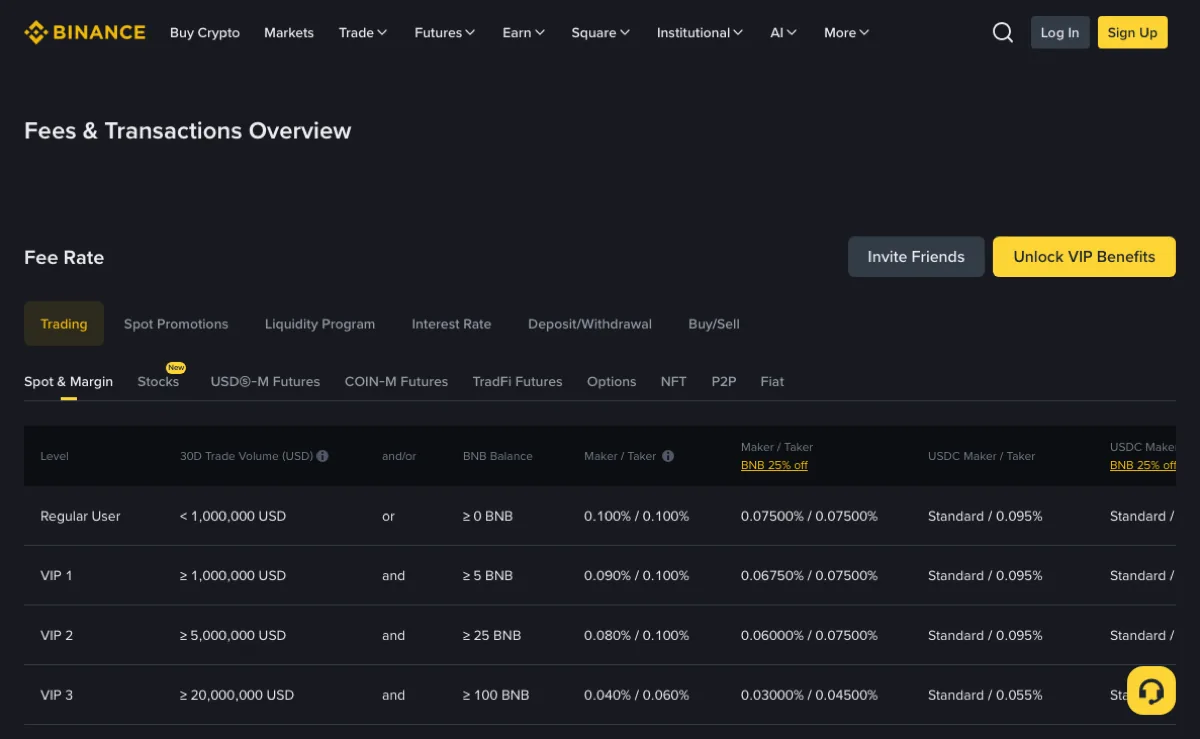
The first thing is the narrow "and/or" column in the middle. The Regular User row says "or". VIP 1, VIP 2 and VIP 3 all say "and": the 30-day volume and the BNB balance both have to be met. Trade your 1,000,000 USD with only 3 BNB in the account and you are still a regular user, paying the regular rate to the cent.
The second is the Maker / Taker column. VIP 1 reads 0.090% / 0.100% and VIP 2 reads 0.080% / 0.100%. The taker fee doesn't budge until VIP 3, where it drops to 0.060%. If you mostly use market orders, or set limit prices that fill the moment they land on the book, you are paying the taker rate nearly every time, and those first two tiers give you nothing. When a single order fills in several pieces and you want to know which side each piece was charged on, checking the fees on a spot order that filled in parts goes through it fill by fill.
Percentages this close together all look alike. Turned into money they don't. The table below is per 10,000 USDT traded, multiplied straight off the fee page; the discount column is the "BNB 25% off" column in the screenshot.
| Tier | Maker | Taker | BNB 25% off | Needs |
|---|---|---|---|---|
| Regular | 10 | 10 | 7.5 / 7.5 | — |
| VIP 1 | 9 | 10 | 6.75 / 7.5 | 1M USD + 5 BNB |
| VIP 2 | 8 | 10 | 6 / 7.5 | 5M USD + 25 BNB |
| VIP 3 | 4 | 6 | 3 / 4.5 | 20M USD + 100 BNB |
Look at the regular user with the discount switched on: 7.5 on a maker fill, which is less than the 9 a VIP 1 pays without it. Until you are anywhere near VIP, that discount toggle is worth more than the tier. What the discount needs, and how it sits next to a referral rebate, is covered in does the referral rebate stack with the BNB discount.
Further right on the same table sit separate columns for USDC pairs, and the numbers there are different. If most of your trading is on USDC pairs, read those columns instead of this table.
A bit short of the line: is it worth trading more to get there?
The people who actually sit down and do VIP maths are usually already trading real size and feel close. Take one of them: 600,000 USD over the last 30 days, 400,000 short of VIP 1.
The fast way to find 400,000 is to buy and sell back and forth. At the regular 0.100% taker rate, that padding alone costs 400 USDT in fees. With the BNB discount, 300. Spread and slippage come on top.
What it buys is 1 USDT less per 10,000 USDT on maker fills for the next 30 days. If your usual 600,000 all fills as maker, that saves 60 USDT in the month. Half taker, 30. All market orders, nothing.
And the window keeps rolling. The volume you padded drops out a day at a time, so holding on to the tier means padding again next month. Pay 300 to 400, get back 60 at best, and do it all over again every month. The 5 BNB also has to stay parked in the account the whole time, and whatever BNB's price does to it lands on you.
The threshold is built for people who already trade that much. Trading more to reach it means paying a big fee up front to buy a small discount.
Binance's help centre page on becoming a VIP also lists routes that don't run through trading volume. One is holding an average of at least 100,000 USDT-equivalent over the last 30 days, again with a daily average of 5 BNB. That is for people with large balances sitting in the account, which is not the reader doing the sums above.
At VIP 3, the referral rebate stops
If you signed up with a referral code and get a spot rebate passed on from your referrer, there is one more line to read: the spot and margin rebate stops once the referred user reaches VIP 3 or above. VIP 3 means 20,000,000 USD over 30 days plus 100 BNB, so not many people get there. If you do and the credits stop arriving, that isn't a system error. How the rebate is settled and where to look for it is in used a referral code but your trading fee didn't drop.
You qualify. When does the lower rate kick in?
The help centre says VIP levels are updated once a day at 08:00 UTC based on the requirements. Anything that fills before that update is still charged at your old tier. Convert 08:00 UTC to your own clock before you plan around it: it is morning in London, but the small hours on the US East Coast.
The BNB condition is where most people's maths goes wrong. It doesn't look at what you hold right now. It takes your average balance across the previous day, 00:00 to 24:00 UTC. Binance's own example: an empty account deposits 25 BNB at 03:00 UTC, holds it for the 21 hours left in the day, and the next day's figure comes out as 25 × 21 ÷ 24 = 21.875 BNB.
Start with no BNB and move exactly 5 BNB in at 03:00 UTC. With no further balance changes, that day averages 5 × 21 ÷ 24 = 4.375, below the requirement. Holding all 5 through the next full UTC day meets the BNB condition for the following day's 08:00 update. A larger deposit changes the timing: at 03:00 UTC, 5 × 24 ÷ 21 ≈ 5.72 BNB is enough to average at least 5 that day and count at the next day's update. The other VIP requirements must also be met; neither example gives an immediate upgrade.
Then there's the trap you can set for yourself. With the BNB discount on, your fees are paid out of that same BNB. Buy exactly 5, keep trading as normal, and a few days of fees pull the daily average under the line. The next update puts you back to regular user.
Your own 30-day volume and BNB balance show on the Fees page once you are logged in. The help centre counts more than spot trading toward the spot volume figure: margin, P2P, Convert and Liquidity Swap are in there too. If you want to know how far off the threshold you are, take the number from that page, not one you worked out in your head, before you open a chat with support.
Is trading volume enough to reach Binance VIP 1?
No. On the Spot & Margin fee table, VIP 1 needs at least 1,000,000 USD of trading volume over the last 30 days and a BNB balance of at least 5 BNB, and the column between the two says “and”, so both must be met. The BNB figure is your average across the previous UTC day, not your balance at the moment, and levels are updated once a day at 08:00 UTC.
How much cheaper is VIP 1 than a regular account?
Only on the maker side. On the Spot & Margin fee table as of September 2026, a regular user pays 0.100% maker and 0.100% taker, while VIP 1 pays 0.090% maker and 0.100% taker. That is 1 USDT less per 10,000 USDT of maker fills and no change on taker fills. A regular user with the BNB discount on pays 0.075%, which is already lower than the VIP 1 maker rate without the discount.